Composite Fence Guide: Styles, Colour, and What to Expect
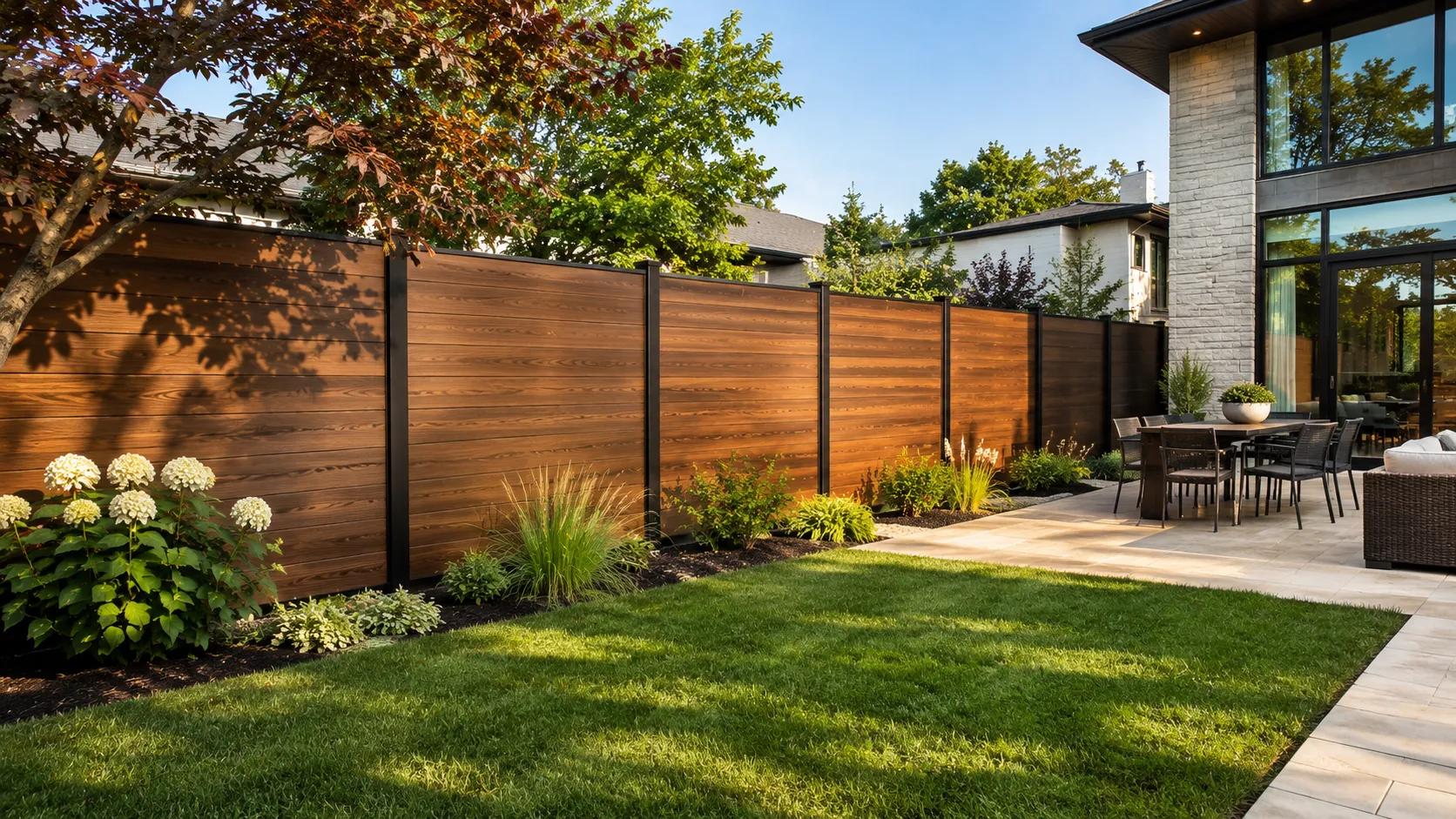
Composite fencing blends wood fibre with plastic to create a panel that looks closer to natural wood than vinyl does, with different maintenance characteristics than either wood or PVC. PrimeAlux offers it as a privacy fence in a woodgrain finish. This guide covers what composite actually is, what separates a higher-quality product from a lower-quality one, and what research says about how it weathers.
Key facts
- Composite requires less upkeep than solid wood, but because it contains a wood component inside the plastic, research shows it can still be susceptible to moisture-related effects like colour change and, in some conditions, fungal colonization.
- Protective capstock layers and better formulations reduce this risk.
- It's not entirely maintenance-free in every climate.
Explore current styles and request pricing
PrimeAlux prices vinyl fencing by quote rather than listing fixed prices, so the fastest way to see current styles and request pricing for your project is directly through PrimeAlux's composite fence.
What is composite fencing made of?
Composite fencing, sometimes called wood-plastic composite or WPC, is made from a blend of wood fibre and a plastic binder. The exact ratio varies by manufacturer and product line, wood content of roughly half the material by weight is a commonly cited example rather than a fixed specification, and it hasn't been confirmed for PrimeAlux's specific product. PrimeAlux offers composite as a privacy fence in a woodgrain finish, which gives it a more natural wood-like texture and colour than solid-colour vinyl.
What separates a higher-quality composite product from a lower-quality one?
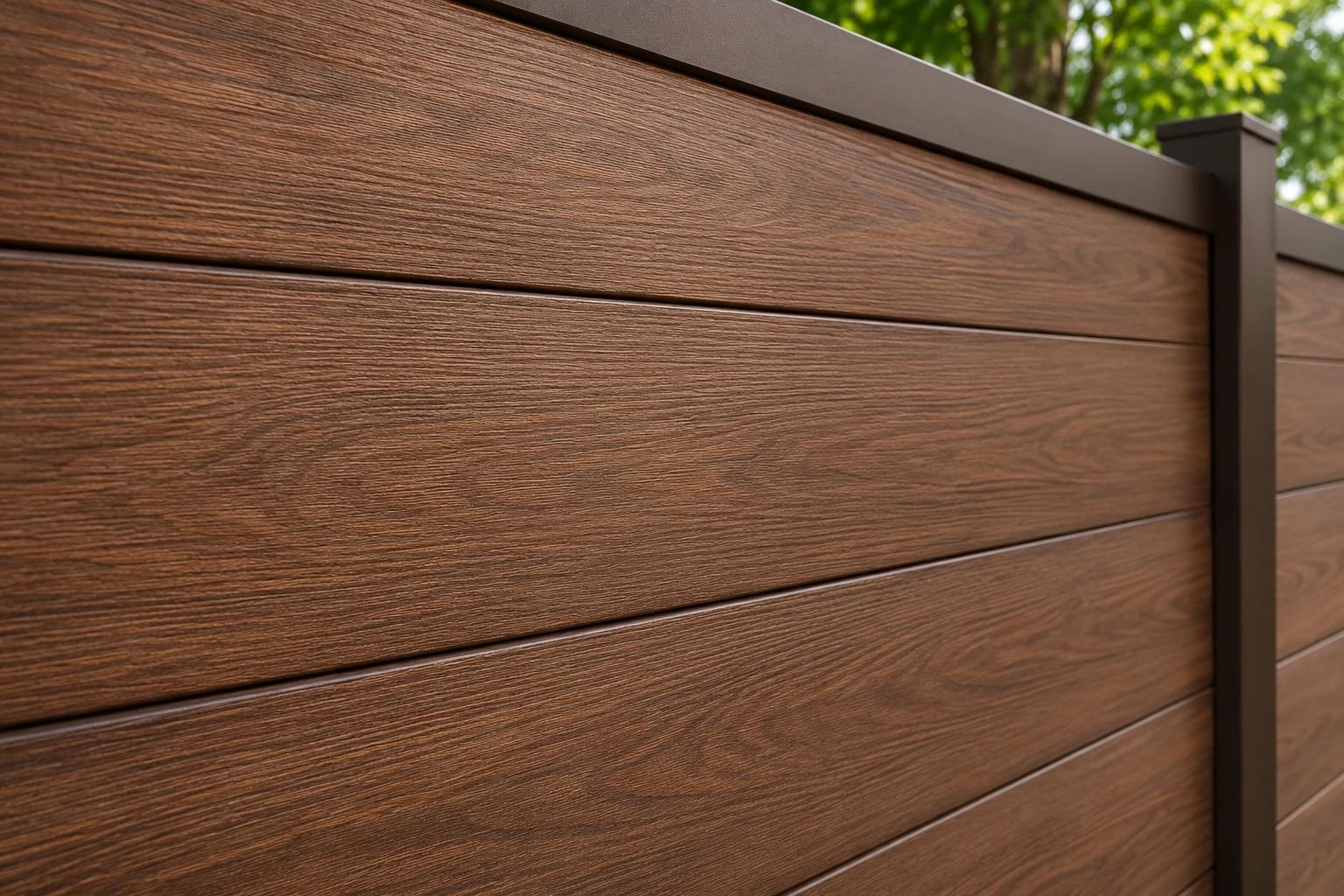
Not all WPC fencing performs the same, and the differences that matter are usually in manufacturing quality rather than the basic wood-plus-plastic concept. A short checklist worth asking any composite supplier, PrimeAlux included, before ordering: Is there a protective outer capstock layer (a plastic-rich surface layer over a wood-plastic core) that reduces moisture absorption into the wood component? How dense and consistent is the extrusion, since that affects how evenly the material weathers? What's the specific wood-to-plastic ratio and plastic type, since both affect UV stability and moisture behaviour? How is the board or profile actually constructed and supported (solid, hollow, internally reinforced)? And what does the warranty cover, confirmed directly rather than assumed. PrimeAlux's capstock type, exact formulation, and warranty terms for composite haven't been published, so these are specifically worth raising at the quote stage rather than assuming a standard across the category.
Aluminum fencing from PrimeAlux
Planning for the long term? Choose aluminum.
- Aluminum does not rust or rot
- Limited warranty of up to 20 years
- Four standard colours
- Class A rated for fire and smoke - ASTM E84 (Privacy Slat | Flame Spread Index 0, Smoke Developed Index 50)
- 220 km/h wind rating (Privacy Plus | posts set underground, not base plate mounting)
- ASTM E90 | Acoustic Performance (Privacy Plus (6'W × 6'H) | STC 22 · OITC 19)
How does composite fencing actually weather?
This is where it's worth separating marketing language from what research on the material actually shows, as a risk to evaluate rather than a reason to rule the category out. Wood-plastic composites can be susceptible to moisture-related degradation: forest products research has found that WPCs can experience fungal colonization, colour change, and some loss of mechanical properties after exterior exposure, since moisture plays a key role in both weathering and fungal degradation of the wood component inside the plastic matrix. A related laboratory study on artificially aged WPCs found that weathering caused cracking of the plastic matrix at the surface and separation between the wood and plastic components, which increased how much moisture the material absorbed over time.
In practice, this means composite's wood content is still a biological material embedded in plastic, which brings in moisture- and fungus-related failure modes that vinyl (PVC) doesn't have. That's not to say PVC's own weathering is purely about UV exposure, either: temperature swings, mechanical loading, and the specific formulation all factor into how a PVC product ages, not UV alone, but the moisture/biological risk discussed above is specific to composite's wood content, and it's a real factor to weigh, not a marketing footnote. It's also not a reason composite fencing performs poorly across the board: protective capstock layers and better formulations specifically address this risk, which is why manufacturing quality is worth asking about directly. Many homeowners find the trade-off worthwhile for the more natural look, though it's worth going in with accurate expectations rather than assuming composite is maintenance-free in every climate.
Get a quote
Ready to price your project?
Send the style, colour, length and height through the contact form, or call (437) 333-3032.
What colour does PrimeAlux's composite fence come in?
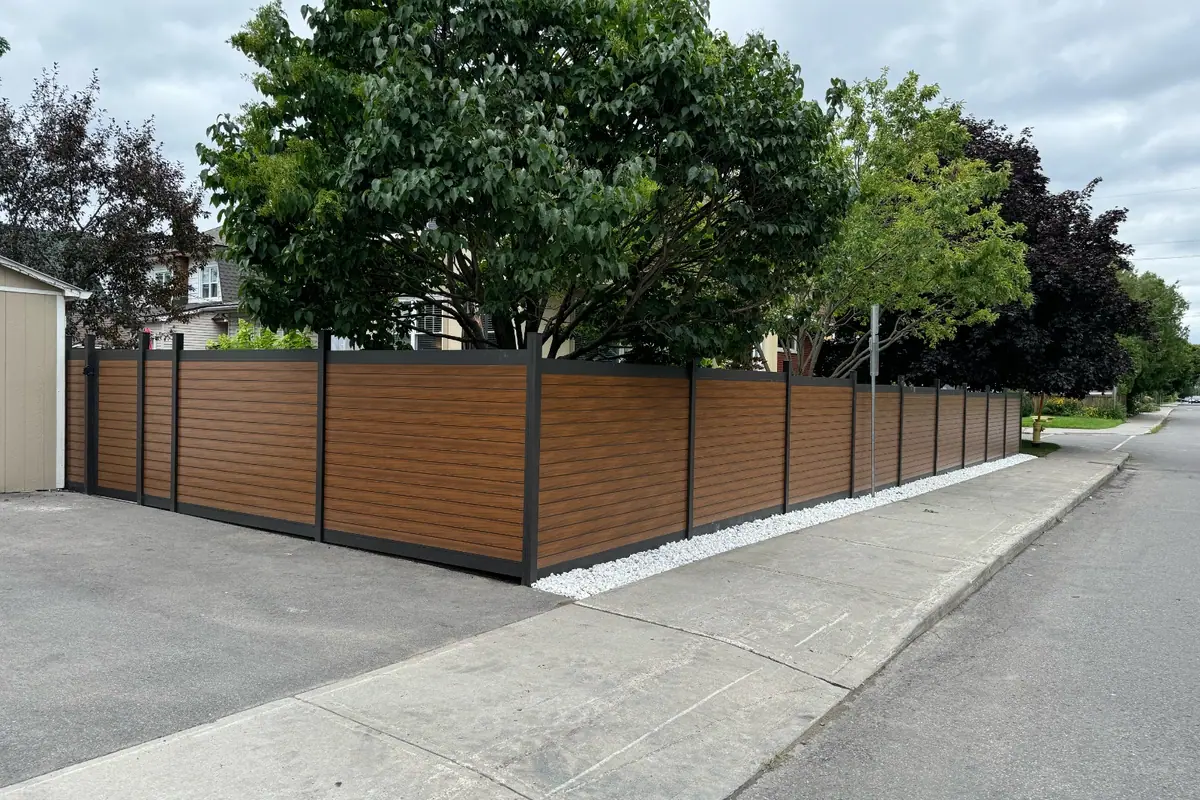
PrimeAlux's composite fence is offered as a privacy fence in woodgrain, which is the style and finish currently available. It doesn't currently come in the broader colour range PrimeAlux's vinyl line offers.
Where does aluminum fit?
Aluminum doesn't contain a wood component, so the moisture-and-fungal failure mode discussed above doesn't apply to it; that's a genuine difference worth knowing, not a reason composite is automatically the wrong choice. For buyers specifically concerned about humid or wet-climate performance, PrimeAlux's aluminum privacy fencing is a useful side-by-side, alongside asking about capstock and formulation quality if composite's wood-textured look is what you want.
How does composite compare to wood directly?
For a deeper look at how composite stacks up against solid wood fencing specifically, including wood's own maintenance and rot considerations, see our composite vs. wood comparison.
What's next?
If a composite privacy fence in woodgrain fits what you're picturing, get a quote with your run length, and ask directly about capstock protection and formulation so pricing and expectations can be confirmed together.
Copy my details for sales
- Customer type
- City and province
- Material
- Fence length
- Fence height
- Anything else we should know
This sheet builds text in your browser. Nothing is sent or saved. Copy the text into your message or email to us.
Frequently Asked Questions
What is composite fencing made of?
A blend of wood fibre and a plastic binder. The exact ratio varies by manufacturer; a roughly 50/50 split by weight is a commonly cited example, not a universal specification, and PrimeAlux's exact formulation hasn't been published.
What style does PrimeAlux offer composite fencing in?
A privacy fence in a woodgrain finish.
Does composite fencing need maintenance?
Composite requires less upkeep than solid wood, but because it contains a wood component inside the plastic, research shows it can still be susceptible to moisture-related effects like colour change and, in some conditions, fungal colonization. Protective capstock layers and better formulations reduce this risk. It's not entirely maintenance-free in every climate.
What makes one composite fence better than another?
Manufacturing quality factors like a protective capstock layer, extrusion consistency, and the specific wood-to-plastic formulation, more than the basic wood-plastic-composite concept itself.
Is PrimeAlux's composite fence Canadian-made?
That hasn't been confirmed for composite specifically, so no origin claim is made here. Confirm directly if this matters to your decision.
Sources
- Ibach, Sun, Gnatowski, Glaeser, Leung & Haight, "Exterior Decay of Wood–Plastic Composite Boards," Forest Products Journal. https://fpj.kglmeridian.com/downloadpdf/view/journals/fpro/66/1-2/article-p4.pdf
- Segerholm, Ibach & Wålinder, "Moisture Sorption in Artificially Aged Wood-Plastic Composites," BioResources. https://bioresources.cnr.ncsu.edu/?p=1254
- USDA Forest Products Laboratory, "Fungal and Moisture Durability of Wood–Plastic Composites" (FPL-GTR-303). https://research.fs.usda.gov/download/treesearch/68010.pdf
Published .
This article is general planning information. Product specifications come from the PrimeAlux product pages and may change. Confirm dimensions, mounting and installation details with PrimeAlux before ordering, and check your local bylaws and permit requirements. This is not engineering or legal advice.