Privacy Dividers for Decks: Best Options for Canadian Outdoor Spaces
If your deck feels more like a fishbowl than a retreat, you’re not alone. Privacy consistently ranks among the top reasons Canadian homeowners add dividers and screening to their outdoor spaces. The real challenge is picking something that survives freeze-thaw cycles, heavy UV exposure, and a Canadian winter without demanding constant attention. This guide covers every major option, explains how they perform in real Canadian conditions, and helps you figure out what actually makes sense for your property.
- Wood and fabric dividers degrade quickly in Canadian climates, particularly through freeze-thaw cycling and UV exposure, often requiring replacement within five years.
- Aluminum privacy panels last 25-plus years with no painting, staining, or structural repairs required.
- PrimeAlux panels are wind-tested to 220 km/h and carry a Class A ASTM E84 fire rating, among the few tested options available in the Canadian market.
- Installed pricing for aluminum deck privacy dividers in Canada typically runs $80 to $120 per linear foot, with no maintenance costs afterward.
What are privacy dividers for decks?
Deck privacy dividers are vertical panels or screens installed along the edges or sides of a deck to block sightlines from adjacent properties, the street, or neighbouring upper-floor windows. They serve one straightforward purpose: turn a deck that feels exposed into a space you actually want to spend time in.
The category covers a wide range. At one end: temporary fabric panels and bamboo rolls you hang from a railing with zip ties. At the other: engineered aluminum panel systems designed for permanent installation with proper post footings, tested structural ratings, and weather-resistant finishes that hold up decade after decade. The gap in real-world performance between those two ends is not small.
Most Canadian homeowners looking for permanent privacy dividers are replacing something temporary that worked fine for a summer or two and then failed. Getting the material decision right the first time is the part that actually saves money.
Why Canadian decks require more from privacy materials
Canada’s climate creates performance demands that don’t apply in most of the U.S. or Europe. Freeze-thaw cycling is the main one. When temperatures swing from -20°C to +10°C and back repeatedly across a single week in March, materials that absorb moisture expand and contract. Wood splits. Cheap vinyl develops hairline cracks or warps. Fabric panels get saturated, freeze, and come apart at attachment points.
UV exposure compounds this. Canada’s summer sun at higher latitudes delivers intense UV radiation through June, July, and August. Wood greys and fades within one to two seasons without regular staining. Vinyl yellows and becomes brittle over time. Powders and surface pigments break down even when the structural material is holding.
Wind loading is the third factor. Exposed suburban and rural properties in particular can see significant lateral forces on anything freestanding. A fabric screen attached to a pergola post with tension wires may work fine in a sheltered Toronto backyard. On a property in southern Alberta that sees chinook events, the same screen is a season-and-a-half project at best.
Any deck privacy solution built to last in Canada has to handle all three of these: thermal movement, UV degradation, and wind load. That narrows the realistic choices considerably.
How the main materials compare for deck privacy dividers
Here is how the most common options stack up against the factors that matter most in Canadian conditions:
| Material | Lifespan (Canadian Climate) | Maintenance Required | Winter Performance |
|---|---|---|---|
| Aluminum | 25+ years | None (occasional rinse) | Excellent; no thermal damage or moisture absorption |
| Cedar wood | 8–12 years structural; looks bad within 1–2 seasons | Stain every 2–3 years; post replacement likely after year 7 | Poor; absorbs moisture, cracks, posts rot below grade |
| Vinyl | ~10 years before warping and cracking begin (less for imported products) | Periodic cleaning; cannot be repaired if cracked | Fair; brittle below -20°C, especially cheaper grades |
| Fabric / bamboo screens | 2–5 years | Must be removed each fall; cannot be left outside year-round | Very poor; degrades or fails if left outside through a Canadian winter |
| Composite | 15–20 years | Low; periodic cleaning | Good; more thermally stable than wood, less brittle than vinyl |
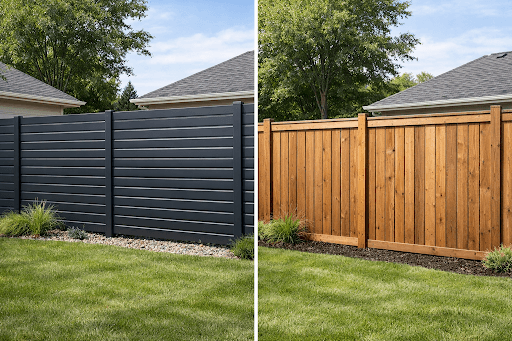
Wood and fabric screens dominate the budget end of the market, and they also account for most of the replacement projects installers get called for. A homeowner puts in cedar panels in spring, they look good through the summer, and by year three or four the grain has opened up, the stain is failing, and the posts show soft spots near grade. The homeowner either restains and resets posts, or upgrades to something that doesn’t need the same cycle every few years.
Why aluminum is the right material for most Canadian decks
Aluminum doesn’t absorb moisture. Freeze-thaw cycles don’t affect it. The finish on quality aluminum panels is applied via a multi-layer coating process, not paint, so there’s nothing to peel, chip, or reapply. UV exposure doesn’t fade the colour. The material is non-combustible. And unlike wood, it won’t develop soft spots, lean, or need structural attention at any point during its service life.
It’s also worth looking at the maintenance cost over time. If you’re staining a cedar privacy wall every two to three years, that’s either your own time or a contractor’s invoice. Over a fifteen-year period, a wood installation that looked cheaper at the start often costs more in total than an aluminum system you’ve touched exactly once.
PrimeAlux aluminum panels are wind-tested to 220 km/h and carry a Class A fire rating under ASTM E84 testing, with a Flame Spread Index of 0 and a Smoke Developed Index of 50. The ASTM E84 standard is widely used in North American building code compliance. A lot of products in the Canadian market carry vague “wind-rated” claims with no test behind them. Tested numbers, by contrast, mean something, and they can matter for any permitting review your municipality requires.
For homeowners who want a wood aesthetic without the wood maintenance, PrimeAlux panels are available in five wood-grain finishes applied via a three-layer coating process: Natural Walnut, Grey Walnut, Walnut, Dark Walnut, and Grey Brown. The finish looks like timber. The material behaves like aluminum. No staining cycle required, ever.
How PrimeAlux panels work as deck privacy dividers
The Privacy Fence Panel is the full solid-slat option, providing complete visual blockage from the bottom rail to the top. For decks where you want to eliminate the view entirely, this is the right panel. The Privacy Plus Panel adds foam-core construction inside each slat, which improves acoustic performance and structural rigidity. If your deck faces a busy road or your neighbour runs equipment outdoors, the foam-core version does noticeably more to reduce ambient sound than the standard panel does.
For decks where airflow and filtered light matter more than complete blockage, the Semi-Privacy Panel uses a spaced-slat design that passes air while still reducing direct sightlines from outside. This works particularly well for elevated second-floor decks where the privacy concern is directional rather than total enclosure. For a full overview of the available panel styles, the Privacy Fence Panels guide covers specifications and use cases in detail.
Panel sizes run from 4′ x 6′ up to 8′ x 8′, with custom configurations available for non-standard deck layouts. Posts need to be set to a minimum of 3 feet below grade for proper structural performance in frost-affected soil. This is deeper than what some contractors set them, and it matters. A post set at 2 feet will move in clay soils once the frost cycles start. More on post depth requirements in this guide: How Deep Should a Fence Post Be?
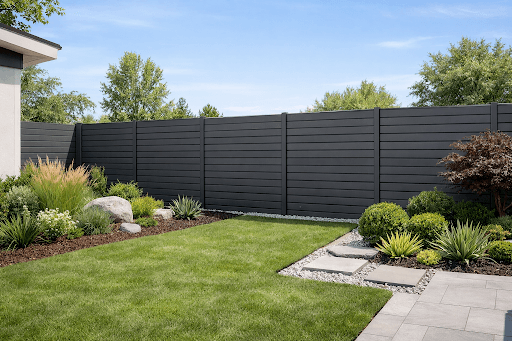
PrimeAlux also makes matching Aluminum Gates in the same finishes and panel styles, so if your deck enclosure includes an access point, the gate integrates cleanly with the rest of the installation.
Installation: what to know before you start
Deck privacy panels can be installed three ways: anchored to the deck structure itself, anchored to independent posts set beside or outside the deck, or attached to an existing pergola or shade structure. Each approach works in different situations.
Anchoring to deck framing is the quickest route, but it only works if the deck was built with enough structural depth to handle the lateral load of a solid panel in a strong wind. Older deck frames or undersized framing may not be adequate. If you’re attaching large solid panels directly to an existing deck, it’s worth a structural assessment before installation, particularly if the deck is more than a few years old.
Independent posts are the cleaner long-term solution. Posts are concreted in at 3 feet below grade alongside or just outside the deck perimeter, and they carry all panel load independently. The deck structure stays the deck structure. This is also the approach that makes it easy to extend screening beyond the deck footprint if the layout calls for it.
Pergola attachment is the fastest option if you already have an existing structure. Panels can be attached to pergola posts without new footings in some configurations, though this depends on how the original pergola was installed and what local code says about it.
Check with your municipality before you start. In Ontario, fence and screen structures above 2 metres typically require a building permit under the Ontario Building Code Act. Other provinces have similar rules, and specific bylaws vary by city. One phone call to your local building department before you dig saves dealing with a stop-work order later.
How much do deck privacy dividers cost in Canada?
For aluminum privacy panels installed by a contractor, the typical range in Canada is $80 to $120 per linear foot, all in. That covers materials, posts, concrete, and labour. Where you land in that range depends on the panel style, the finish chosen, site conditions, and local labour rates. Urban markets like Toronto and Vancouver tend toward the higher end; mid-sized Ontario and Prairie markets usually come in lower.
Fabric and bamboo screens cost less upfront, typically $10 to $40 per linear foot installed, but factor in that most require removal each fall in colder climates, provide very little structural resistance to wind, and need replacement every few years. Cedar comes in at roughly $40 to $85 per linear foot installed, but staining costs every two to three years and likely post replacement by year seven add to the total considerably.
Over a fifteen-year horizon, the total cost of aluminum often comes out comparable to or lower than wood once maintenance and replacement are factored in, and without the time investment that wood requires. The Fence Cost Estimator Canada guide breaks down material pricing by situation in more detail if you want to run the numbers for your specific project.
Privacy additions also tend to have a positive effect on property value in most Canadian markets. According to the Canada Mortgage and Housing Corporation, outdoor space improvements are among the residential upgrades that contribute to resale value in Canadian markets. The Does a Privacy Fence Increase Home Value? post covers the data on this in more detail. If you’re comparing aluminum and wood from an investment standpoint, the comparison in the Aluminum Fence vs Wood Fence guide is worth reading before you decide.
What Canadian homeowners most often get wrong
The most common mistake is choosing based on upfront cost without accounting for the ongoing costs of the material. A cedar privacy screen at $3,000 installed sounds better than an aluminum system at $5,500. After two staining cycles and a post replacement in year seven, the cost gap has closed or reversed, and you’ve put in several weekends of maintenance time on the cheaper option.
The second is treating temporary fabric or bamboo screens as a permanent solution. They look reasonable in the first summer. The problem shows up when you either leave them out over winter and they’re damaged, or you take them down each fall and realize the labour is more than you anticipated.
The third is skipping the post depth. A well-built panel on shallow posts will shift. Three feet is the minimum in frost-prone soil. If you’re overseeing an installation, confirm the post depth before the concrete goes in. It’s a question that takes thirty seconds to ask and can save a significant correction a few years down the road.
Frequently asked questions about privacy dividers for decks
What is the best material for deck privacy dividers in Canada?
Aluminum is the most practical choice for Canadian conditions. It handles freeze-thaw cycling without warping or cracking, requires no staining or painting, and quality panels come with verifiable wind and fire ratings. Wood and fabric options require ongoing maintenance and typically fail or need significant repairs within five to ten years in colder climates.
Do I need a permit for deck privacy dividers in Canada?
In most Canadian cities, privacy structures above 2 metres require a building permit. Some municipalities have lower thresholds, and rules vary between attached and freestanding structures. Contact your local planning or building department before starting any installation, particularly for structures that involve footings or post-setting.
How are deck privacy panels installed?
The three main approaches are: anchoring to the deck frame, setting independent posts in concrete beside the deck, or attaching to a pergola structure. Independent posts set at 3 feet below grade are the most structurally reliable method for permanent panels. The right approach depends on your existing deck structure and site conditions.
How long do aluminum deck privacy panels last in Canadian conditions?
Quality aluminum panels installed with proper post depth last 25 years or more. The material doesn’t absorb moisture, so freeze-thaw cycles don’t damage it. Multi-layer coatings hold the finish without fading or peeling. Unlike wood, there’s no staining schedule and no post-replacement cycle to plan for.
What is the difference between a privacy screen and a privacy divider for a deck?
The terms are often used interchangeably. A privacy screen typically refers to a panel used to block a specific sightline, sometimes freestanding. A privacy divider usually refers to a fixed panel between posts along the deck perimeter. Both serve the same core function. For a full look at privacy screen options, this guide covers the category in detail: Aluminum Privacy Screen: The Permanent Alternative to Fabric and Bamboo.
Can PrimeAlux fence panels be used as deck privacy dividers?
Yes. PrimeAlux Privacy Fence Panels, Privacy Plus Panels, and Semi-Privacy Panels are all suitable for deck applications. The system is designed for freestanding installation with post footings, which works for both property-line fencing and deck-perimeter privacy. Panel sizes run from 4′ x 6′ to 8′ x 8′, with custom sizes available for non-standard configurations.
How much does a deck privacy divider cost in Canada?
Aluminum privacy panels run $80 to $120 per linear foot installed in most Canadian markets, depending on panel style, finish, site conditions, and local labour rates. Wood options start lower (around $40 to $85 per linear foot) but add maintenance and eventual replacement costs over time. Fabric and bamboo screens are cheaper upfront but rarely last more than two to five years in Canadian climates without being taken down each winter.
Do deck privacy panels reduce noise as well as block views?
Solid panels do reduce ambient noise to some extent. PrimeAlux’s Privacy Plus panels, which use foam-core construction inside the aluminum slats, offer better acoustic dampening than standard solid panels. They won’t eliminate traffic noise entirely, but they make a noticeable difference compared to open fencing. For stronger noise reduction, pairing solid panels with soft landscaping on the outside of the structure adds further dampening.