Fence Cost Estimator Canada: How to Budget Your Fence Project
Getting an accurate fence cost estimate in Canada is harder than it should be. Most online calculators use American pricing, which doesn’t account for Canadian lumber costs, regional labour rates, or the frost conditions that change how posts need to be set. This guide breaks down what fencing actually costs per linear foot across materials, what makes quotes vary so widely, and how to build a realistic budget for your project.
All prices below are general Canada-wide installed estimates (materials and labour together, not materials alone) for standard residential fence heights, current as of 2026. They're a planning range, not a quote — location, exact height, panel style, and site conditions all move the number. Get a project-specific quote for your address.
- Installed fence costs in Canada range from $15/linear foot (chain link) to $120/linear foot (premium aluminum)
- Labour typically makes up 40–60% of the total installed project cost in most Canadian markets
- Wood and vinyl carry significant ongoing costs beyond installation: staining, repairs, and early replacement cycles
- Aluminum costs more upfront but has a 10-year total cost that often equals or beats wood when maintenance is factored in
How Much Does a Fence Cost Per Linear Foot in Canada?
Installed fence costs in Canada range from about $15 per linear foot for basic chain link up to $120 per linear foot or more for premium aluminum privacy systems.
| Material | Installed Cost ($/LF) | Lifespan | Annual Maintenance |
|---|---|---|---|
| Aluminum (premium) | $80–$120 | 25+ years | $0 (occasional rinse only) |
| Cedar wood | $35–$85 | 8–12 years structural | $2–$5/LF for staining |
| Vinyl (quality grade) | $40–$95 | ~10 years before degrading | $1–$3/LF (panel repair) |
| Pressure-treated wood | $25–$55 | 7–10 years structural | $2–$5/LF |
| Chain link | $15–$40 | 15–20 years | Near zero |
These figures are general Canada-wide installed-cost ranges (materials and labour), current as of 2026. Regional labour rates, exact fence height, and site conditions all move the final number — treat this as a planning range, not a quote. Labour accounts for 40–60% of the total installed cost. On a $12,000 project, roughly $5,000–$7,000 is skilled installation, not materials.
The Four Numbers You Need for an Accurate Estimate
You need four inputs: total linear footage, gate count and type, your chosen material, and lot conditions. Multiply linear footage by the installed per-foot rate, add gates separately, and adjust upward for difficult site conditions. That gives you a working number before you pick up the phone.
Total linear footage
Walk the boundary you plan to fence and measure in feet. Most suburban backyard projects in Canada run between 100 and 300 linear feet. If you have a property survey, the boundary dimensions are usually on it.
Gate count and type
Gates are a separate line item, and the price depends heavily on which type you mean — "aluminum gate cost" isn't one number. As installed figures: a single pedestrian gate (3–4 ft) runs $500–$2,000; a wide or double pedestrian gate (5–8 ft) runs $1,500–$3,500; a manual driveway gate (swing or sliding) runs $2,500–$5,200; and an automated driveway gate (motor, photo eyes, remotes included) runs $4,500–$8,500. See our sliding gate hardware guide for the itemized breakdown behind the driveway-gate figures. Make sure any quote specifies gates separately from the fence run, and confirms whether the number quoted is the gate leaf alone or the fully installed price.
Lot conditions and soil type
Flat, cleared lots with consistent soil are the baseline. Slopes, rocky or clay-heavy soil, and mature trees each add 10–25% to your labour line.
Post depth for Canadian frost zones
Posts in most of Ontario, Quebec, and the prairie provinces need to be set at least 3 feet deep to account for frost heave. Proper frost-depth installation adds excavation cost but prevents far more expensive problems later. Any quote that doesn’t address post depth is worth questioning.
What Wood Fencing Really Costs Over 10 Years
Cedar fencing in Canada now runs $35–$85 per linear foot installed, depending on design and local labour rates. That number only covers year one. A properly maintained cedar fence needs professional staining or sealing every 2–3 years (roughly $2–$5 per linear foot per application). On 150 linear feet, that’s $300–$750 every couple of years. Most homeowners skip this, and the fence shows it.
When maintenance is skipped, cedar greys and cracks within 1–2 seasons in Canadian climates. Wood fence posts are vulnerable at the soil line, where moisture and freeze-thaw cycles break down the wood. A rotten post requires excavating the old footing and starting over. That is rarely a simple swap. See the aluminum vs wood fence comparison for what these costs look like over a realistic ownership period.
A cedar fence installed for $5,750–$14,750 on a 150-linear-foot project with one gate might require $2,000–$4,500 in maintenance over its life and a full replacement of $10,000–$15,000 at year 8–12. The total 20-year cost often exceeds what a single aluminum installation would have cost.
What Vinyl Fencing Really Costs Over Time
Vinyl’s appeal is no painting. That is true for the first several years. The issue in Canada is that vinyl becomes brittle below -20°C, a temperature that arrives every winter across Ontario, Quebec, and the prairies. Cracked vinyl cannot be repaired. The panel has to be replaced. The aluminum vs vinyl comparison covers cold-weather performance in more depth.
Quality vinyl can hold up for around 10 years. Cheaper imported products begin showing problems much earlier. When vinyl fails, you pay for new panels and installation. There is no repair option.
10-Year Total Cost Comparison: 150-Foot Fence With One Gate
Here is what a 150-linear-foot project with one pedestrian gate looks like across materials in a mid-tier Canadian urban market, including installation and maintenance over 10 years.
| Cost Category | Aluminum (PrimeAlux) | Cedar Wood | Vinyl |
|---|---|---|---|
| Initial install (150 LF + 1 pedestrian gate) | $12,500–$20,000 | $5,750–$14,750 | $6,500–$16,250 |
| Maintenance over 10 years | $0 | $2,000–$4,500 | $500–$1,500 |
| Partial replacement or repair | Unlikely | $2,000–$5,000 | $1,000–$4,000 |
| 10-year total (estimated) | $12,500–$20,000 | $9,750–$24,250 | $8,000–$21,750 |
| Condition at year 10 | Same as day one | Declining; replacement likely | Faded or brittle; replacement needed |
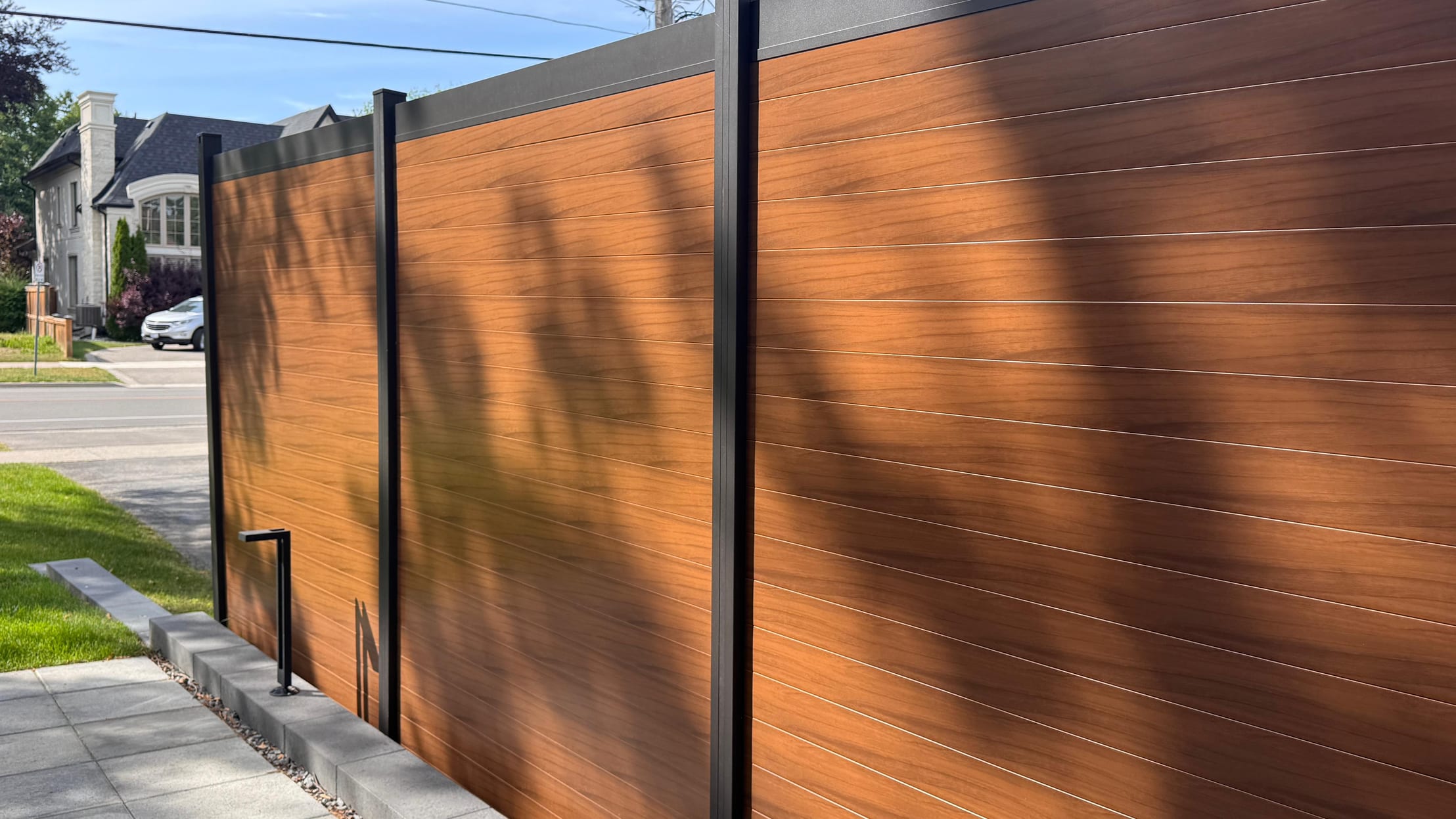
The 10-year totals overlap at the high end. A maintained cedar fence can cost nearly as much as aluminum over a decade. The difference is what you get at year 10. An aluminum fence looks the same as installation day. Wood and vinyl are heading toward replacement.
There is also the property value question. A fence in good condition contributes to home value and curb appeal; a deteriorated one does the reverse.
Why Fence Quotes in Canada Vary So Much
Three quotes for the same fence can vary by $4,000–$8,000. Lower quotes often reflect trade-offs: shallower post depth, thinner gauge materials, less concrete per post, or subcontracted labour. Higher quotes from established local contractors may reflect deeper excavation, verified material specs, and workmanship that holds up after the first hard winter.
None of those differences appear in the quote document. They show up in the fence, 2–3 years later. Asking for post depth, concrete volume per post, and material gauge forces contractors to put specifics on paper.
Spring is typically the most expensive time to book fencing in Canada. Fall installations often come in lower as contractor schedules open up and demand drops.
Permits for Fences in Canada
Most municipalities do not require a permit for a standard residential fence under 2 metres (roughly 6.5 feet), but there are exceptions. Fences near driveways, sight-line corners, shared boundaries, or heritage districts may have specific rules. Pool fencing has mandatory code requirements in every province regardless of height.
Check with your local building department before starting any project that exceeds 1.8 metres or runs along a shared boundary. A permit, when required, typically costs $50–$200. Removing a fence built without required permits costs considerably more.
How to Get Quotes You Can Actually Compare
Prepare the following before contacting any supplier: your measured linear footage, gate count and preferred type, any known lot conditions, your municipality’s height and setback rules, and your preferred material with one alternative for comparison. Providing this upfront gets you accurate numbers instead of ballpark estimates.
When you request a quote from PrimeAlux, you can specify panel style: full privacy panels, semi-privacy panels, or the Privacy Plus foam-core system, along with height, colour, and gate requirements. Panel sizes run from 4 by 6 feet up to 8 by 8 feet, with custom sizing available on request.
All PrimeAlux systems are wind-load tested to 220 km/h and carry a Class A fire rating under ASTM E84: a Flame Spread Index of 0 and a Smoke Developed Index of 50. Most fence suppliers do not publish performance data like this because they have not run the tests. For a full breakdown of aluminum fence pricing, see the aluminum fence cost Canada guide.
Frequently Asked Questions About Fence Cost in Canada
What is the average installed fence cost per linear foot in Canada?
Installed fence costs in Canada run from $15 per linear foot for basic chain link to $120 or more for premium aluminum privacy systems. Cedar wood typically runs $35–$85, vinyl runs $40–$95, and aluminum runs $80–$120. These are general Canada-wide planning ranges, current as of 2026 — labour makes up roughly 40–60% of the total installed price, so the material rate is only one part of your final number, and your exact location and fence height will move it further.
How do I estimate the total cost of a fence project in Canada?
Measure your total linear footage and multiply by the installed per-foot rate for your chosen material. Add a gate cost by type: $500–$2,000 for a single pedestrian gate, $1,500–$3,500 for a wide or double pedestrian gate, $2,500–$5,200 for a manual driveway gate, or $4,500–$8,500 for an automated driveway gate. Adjust upward by 10–25% for difficult lot conditions. In most of Canada, budget for posts set at least 3 feet deep to handle frost heave, which adds excavation cost but prevents far more expensive issues down the road.
Why does fence installation cost more in Canada than in the US?
Canadian fence installation costs exceed US benchmarks due to higher labour rates, a compressed installation season, frost-depth requirements that demand deeper post-setting and more concrete, and material costs priced in Canadian dollars. Projects in Greater Toronto, Vancouver, and Calgary carry additional labour premiums compared to smaller markets.
Is aluminum fencing worth the higher upfront cost in Canada?
For most residential projects, yes. Aluminum costs $80–$120 per linear foot but requires zero maintenance and holds its appearance for 25 or more years. Wood needs $2,000–$5,000 in maintenance over 10 years, followed by full replacement. The 10-year total cost of aluminum and well-maintained wood often comes out comparable, though the outcome at year 10 is very different: aluminum still looks new, wood is heading toward its next replacement.
What hidden costs does wood fencing carry in Canada?
Beyond installation, wood requires staining or sealing every 2–3 years ($2–$5 per linear foot per application), post repair or replacement as rot develops, section replacement after damage or warping, and reduced sale appeal if the fence hasn’t been maintained. These costs rarely appear in initial quotes, making wood look cheaper than it is over a realistic ownership period.
How much does an aluminum fence gate cost in Canada?
It depends on the gate type, and "aluminum gate cost" isn't one number. A single pedestrian gate (3–4 ft) runs $500–$2,000 installed. A wide or double pedestrian gate (5–8 ft) runs $1,500–$3,500. A manual driveway gate (swing or sliding) runs $2,500–$5,200. An automated driveway gate, with motor, photo eyes, and remotes included, runs $4,500–$8,500. Always spec a gate from the same manufacturer as your fence panels, and confirm whether a quoted price is the gate leaf alone or the fully installed cost; mismatched materials look wrong immediately and can create alignment issues over time.
How much does it cost to fence a backyard in Canada?
For a typical suburban backyard with 150 linear feet and one pedestrian gate, expect $12,500–$20,000 for an aluminum privacy fence system, $5,750–$14,750 for cedar, or $6,500–$16,250 for quality vinyl. Larger lots, difficult soil, or premium configurations push costs above these ranges. Getting two or three quotes from local contractors is the fastest way to establish an accurate baseline for your area.
What should I ask a fence contractor before signing a quote?
Ask for post depth in feet, concrete volume per post, the specific material brand and wall gauge, whether the quote includes permit application if required, and how post movement or failure is handled under their workmanship guarantee. A contractor who answers these questions clearly is giving you a quote you can evaluate. One who cannot may be leaving important variables out of the document.