Aluminum Fence Lifespan: How Long Does an Aluminum Fence Really Last in Canada?
Quick Summary
A quality aluminum fence in Canada lasts 25 years or more with no structural maintenance, while wood lasts 8 to 12 years and vinyl typically begins cracking around the 10-year mark. Lifespan depends on alloy grade, coating quality, post installation depth, and climate exposure. Aluminum wins because it does not rot, rust through, warp, or crack in freeze-thaw cycles, and a 3-layer powder-coated finish holds colour and gloss for decades. PrimeAlux panels are tested to a 220 km/h wind load and rated Class A for fire under ASTM E84, with foam-core construction on the Privacy Plus line for added rigidity.
How long does an aluminum fence really last in Canada?
A properly installed aluminum fence in Canada lasts 25 years or longer without structural failure. The aluminum itself does not rot, rust through, or break down under UV exposure, and a quality powder-coated finish typically holds its colour and gloss for the same span. The post system, the coating, and the install depth are the three factors that decide whether a fence reaches 25 years looking respectable or whether it starts looking tired by year 15.
That number assumes a few things. The alloy is residential or commercial-grade, not the thin-wall imported stock that some big-box brands sell as “aluminum” without specifying a grade. The posts go below the frost line, which in most of Canada is a minimum of 3 ft. And the finish is a multi-layer architectural coating rather than a single-pass paint job. PrimeAlux panels are built to those standards and tested to a 220 km/h wind load, which gives a useful baseline for what “long-lasting” actually looks like in practice.
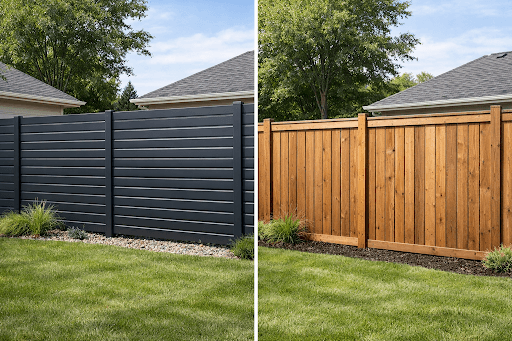
Compare that to other materials and the gap widens fast. Wood fences in Canadian climates start showing cracks, warps, and grey patches within 1 to 2 seasons regardless of stain, and most are functionally done by year 10. Vinyl looks fine for the first 5 to 7 years, but cold snaps below -20°C make it brittle, and once a panel cracks the whole section needs replacing. Chain link survives mechanically for decades but starts looking industrial from day one and rusts at the welds. Aluminum versus wood and aluminum versus vinyl have already been covered on this blog, so this guide focuses on the durability question itself: what lasts, what fails, and what actually drives that 25-year number.
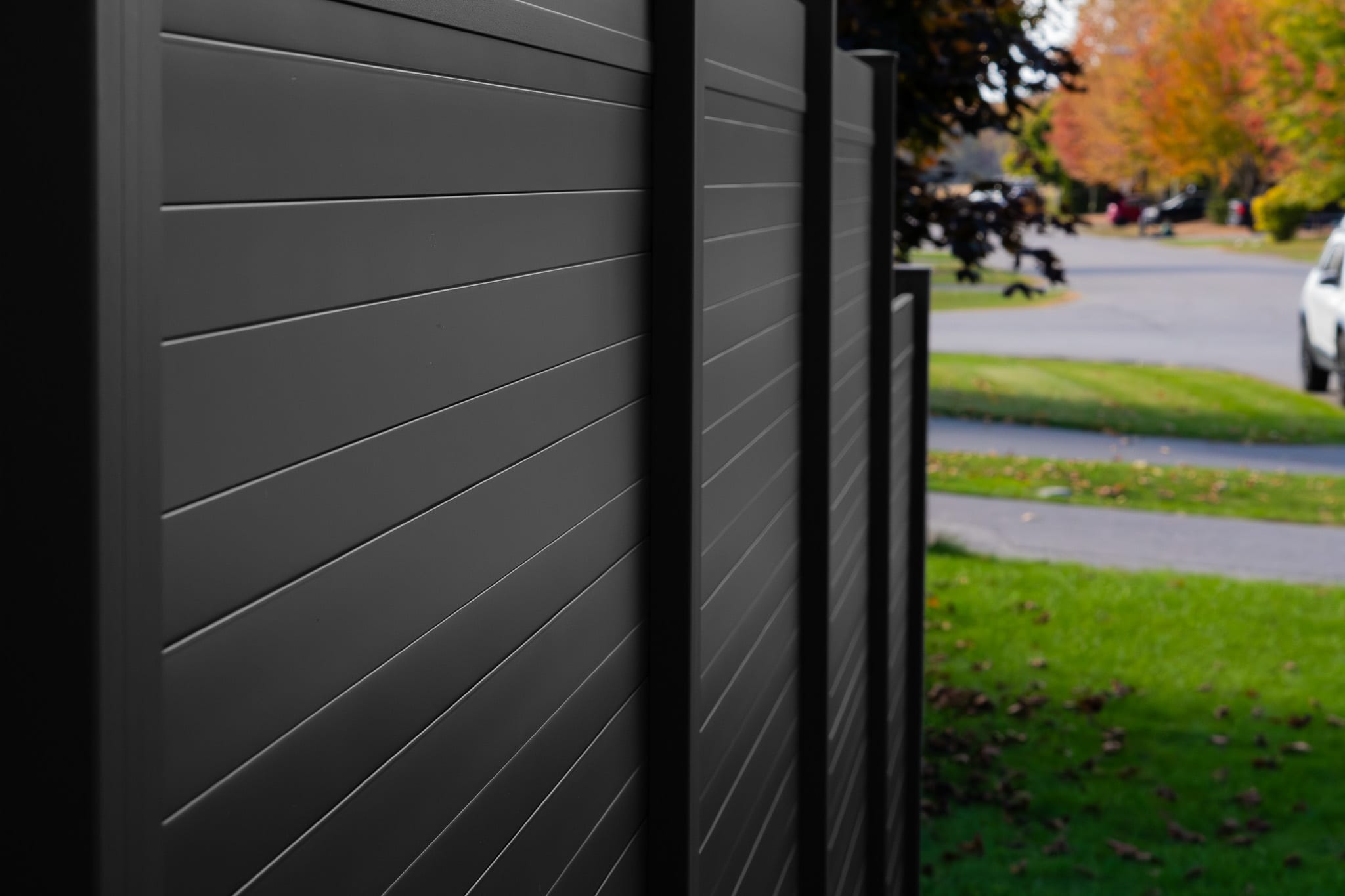
What determines aluminum fence lifespan?
Five variables decide how long any aluminum fence lasts. Get all five right and 25 years is conservative. Get even two wrong and the fence will look tired well before year 15.
Alloy grade. Architectural aluminum used in fencing is typically 6005 or 6063 series, which are corrosion-resistant and hold paint well. Cheap “aluminum” fence panels imported at the lowest possible spec sometimes use thinner walls and lower-grade alloys, which dent more easily and twist under wind load. The Aluminum Association notes that aluminum’s natural oxide layer protects the metal from atmospheric corrosion, but the alloy itself still matters for structural rigidity.
Coating quality. A single-coat polyester powder will fade and chalk in 8 to 12 years of full-sun Canadian exposure. A 3-layer architectural finish, by contrast, is built to hold colour and gloss for the practical life of the fence. PrimeAlux uses a 3-layer process for all wood-grain finishes (Natural Walnut, Grey Walnut, Walnut, Dark Walnut, Grey Brown), and the same multi-coat approach for the solid colours.
Wind and load resistance. A privacy fence acts like a sail in high winds. Posts that are undersized, set in narrow holes, or buried less than the local frost depth can lean or pull within a few seasons. PrimeAlux Privacy Plus panels are tested to a 220 km/h wind load, which is well beyond what most Canadian regions ever see and gives the system a large safety margin against everyday storms.
Post depth and footing. Frost depth in Canada ranges from about 4 ft in the Prairies and northern Ontario to roughly 3 ft in coastal British Columbia. The minimum burial recommended for a privacy fence post is 3 ft, with a concrete footing wider than the post, set on a gravel base for drainage. Posts buried shallower than the frost line will heave every spring and the fence will go out of plumb within a few cycles.
Climate exposure. Coastal salt air, desert UV, and heavy industrial atmospheres all accelerate coating wear, but none of them rot or rust aluminum the way they affect wood and steel. Environment and Climate Change Canada has tracked rising freeze-thaw cycles in southern Ontario and Quebec, which is hard on porous materials like wood and concrete but largely irrelevant to aluminum.
Aluminum vs other fence materials: real lifespan comparison
The honest version of the lifespan comparison is not the marketing version. Wood does not “last 15 years,” it stands for that long while looking progressively worse from year 2 onward. Vinyl does not have a 30-year warranty in any meaningful sense, because the fine print usually excludes the most common failure modes. Here is what each material actually does in Canadian conditions:
| Material | Realistic lifespan (Canada) | When it starts looking bad | Maintenance required | Main failure modes |
|---|---|---|---|---|
| Aluminum (PrimeAlux) | 25+ years | Holds finish for the practical life of the fence | Occasional rinse with water | None material |
| Cedar wood | 8 to 12 years structural | 1 to 2 seasons (greying, cracking) | Stain every 2 to 3 years | Rot at posts, warping, splitting, leaning |
| Pressure-treated wood | 7 to 10 years | 1 to 2 seasons | Re-treatment, stain, repairs | Warping, post rot below grade, twisted boards |
| Vinyl (PVC) | ~10 years before issues | 5 to 7 years (yellowing, brittleness) | Periodic cleaning | Cracking in cold, warping in heat, brittleness, no repairs possible |
| Chain link | 20+ years mechanically | Day one (industrial look) | Low | Sagging, rust at welds, no privacy or aesthetic value |
The 10-year vinyl figure assumes a quality North American product. Imported low-spec vinyl panels, which dominate the budget end of the market, often show cracking and fading much sooner. Once vinyl fails, the entire section has to be replaced because the panels cannot be repaired. Wood is the opposite problem. It stays standing for a decade but the appearance deteriorates so quickly that most homeowners either repaint constantly or live with an eyesore.
Pro Tip – How to read a fence lifespan claim
If a manufacturer quotes a lifespan in years, ask three questions. What test data backs it up? What is the warranty actually covering? And what are the common exclusions? Many fence warranties exclude “normal weathering,” which is the exact failure mode the warranty seems to cover. Look for verifiable test data like the ASTM E84 fire rating and a stated wind load, and avoid generic claims like “lifetime” or “industry-leading.”
Why aluminum outlasts wood and vinyl in Canadian conditions
Aluminum’s lifespan advantage comes down to chemistry and structure. The material develops a thin, self-protecting oxide layer when exposed to air, which prevents the kind of progressive corrosion that destroys steel and iron over time. According to the International Aluminium Institute, this oxide layer is one of the reasons aluminum is used in long-life applications from aircraft skins to building cladding.
Wood, by contrast, is biologically active. The USDA Forest Products Laboratory publishes detailed research on wood decay, and the short version is that any wood in contact with soil or repeatedly wet surfaces will support fungal growth that breaks down the cell wall. Pressure treatment slows this, but does not stop it. The post-ground interface is almost always where wood fences fail first, with the visible boards still looking serviceable while the buried portion is already compromised.
Vinyl is a polymer, and polymers respond poorly to repeated thermal cycling. Below roughly -20°C, PVC becomes brittle and impact-prone. Above 35°C, it softens and warps. Canadian climate cycles between those two extremes routinely in many regions. UV exposure also degrades the surface over time, which shows up as yellowing, chalking, and loss of gloss.
Aluminum has none of those failure modes in the temperature ranges Canada experiences. The metal stays dimensionally stable from -40°C to +40°C, the coating is engineered for UV stability, and there is no biological pathway to decay. That is why a well-built aluminum fence reaches the 25-year mark routinely, while wood and vinyl rarely do without ongoing intervention.
What can shorten an aluminum fence’s life?
Aluminum is the most forgiving fence material on the market, but it is not invulnerable. A few specific situations can shorten the life of an otherwise well-built panel system, and they are worth understanding before installation.
Galvanic corrosion. When aluminum is in direct contact with a dissimilar metal in the presence of moisture, the less noble metal corrodes preferentially. In a fence, this typically shows up at fasteners. Stainless steel or aluminum hardware is fine. Plain steel screws or galvanized hardware in direct contact with aluminum can cause pitting around the contact point over time, especially in coastal areas.
Coating damage. A scratch deep enough to expose bare aluminum will not rust through, but it can let water under the coating and cause localized lifting if not touched up. Most installers carry a matching touch-up paint for this exact situation. The 3-layer architectural coating system is much more resistant to scratching than a single-coat finish, which is why lower-quality panels show coating wear sooner.
Improper post installation. A fence is only as durable as its posts. Posts set in shallow holes, posts not in concrete, or posts in soil that does not drain will all cause the fence to lean or heave. The fence panels themselves can outlast three sets of bad posts. Insist on the burial depth and concrete footing being done correctly, and the panels will reward you with decades of service. Aluminum fence post sizing and depth is covered in detail in a separate guide.
Severe physical impact. Aluminum dents under heavy impact, the same as a car panel does. Snowplows, vehicle impacts, or fallen tree branches can put a visible dent in a slat or rail. Replacing a single panel is straightforward on a properly designed system, but it is worth keeping a spare panel from the original install if the colour or finish is non-standard.
Salt exposure on the coastline. Salt-laden air will eventually wear any coating. Aluminum will not corrode through, but the finish can dull faster than inland equivalents. A coastal install benefits from a more frequent rinse with fresh water (twice a year is plenty) to remove accumulated salt deposits before they settle into the coating.
How to maximize the life of your aluminum fence
Maximizing aluminum fence lifespan is mostly about avoiding the few things that can shorten it. The fence itself does not need maintenance in any meaningful sense. Most of the longevity work happens at install, and the rest is just basic care.
First, specify the right product for the application. Privacy panels need different wind-load characteristics than ornamental picket panels, and the manufacturer should publish actual test data. PrimeAlux Privacy Plus uses foam-core construction that adds rigidity to the slat assembly and helps the panel hold tight tolerances over years of thermal cycling. The same panels are Class A fire-rated under ASTM E84 with a Flame Spread Index of 0 and a Smoke Developed Index of 50, which adds another layer of utility for properties in wildfire-aware regions like the BC interior.
Second, install posts to the local frost depth at minimum. In southern Ontario this is around 4 ft. In coastal BC it is closer to 3 ft. Concrete footing, gravel drainage base, and proper plumb at install will eliminate the most common cause of fence failure across all materials.
Third, do an annual walk-around. Look for coating damage, loose hardware, and any fence panel that has gone slightly out of plumb (an early sign of a post starting to shift). Touch up coating chips with manufacturer-supplied paint, snug any hardware that has worked loose, and address any leaning posts before they take other panels with them. Aluminum fence maintenance is essentially that walk-around plus an occasional rinse with a garden hose.
Fourth, keep landscaping back from the fence. Dense vines, climbers, and irrigation spray patterns aimed directly at the fence will not damage it the way they would damage wood, but they hold moisture against the surface and trap debris. A 30 cm gap of bare soil or mulch along the fence line keeps the fence drier and easier to clean.
Lifespan vs warranty: what the numbers actually mean
Manufacturer warranties and real-world lifespan are not the same thing. A warranty defines what the manufacturer will replace and under what conditions. Lifespan is what the product actually does in the field. Both matter, but for different reasons.
A long warranty on a fence panel is meaningful only if the warranty covers the failure modes that actually happen. Many fence warranties contain clauses that are nearly impossible to enforce: requiring annual professional inspection, specific cleaning products, written notice within 30 days of any defect, or proof of purchase that most homeowners do not retain a decade later. Some warranties exclude colour fade and “normal weathering,” which is exactly the issue that drives most homeowner complaints.
The practical question to ask is not “how long is the warranty,” but “what is the manufacturer willing to back up with verifiable test data?” A wind load tested to a specific number, a fire rating tested to a published standard, and a coating warranted for a stated number of years against pinhole corrosion are all useful. Vague claims like “lifetime structural” with no defined failure threshold are mostly marketing.
For pricing context, residential aluminum fence in Canada typically runs $80 to $120 per linear foot installed, and a 25-year service life works out to roughly $3 to $5 per linear foot per year. Cedar wood at the lower end of that price range, replaced every 10 years, ends up costing more per year of service once you factor in the staining cycle and removal of the old fence. Detailed numbers are in the aluminum fence cost guide and the aluminum fence pricing in Canada post.
Frequently asked questions
Can an aluminum fence last 50 years?
The aluminum itself is fully capable of lasting 50 years or longer, since the metal does not rot, rust through, or break down chemically. The practical limit is usually the coating system. A 3-layer architectural coating typically holds colour and gloss for 25 to 30 years, after which the finish may dull or fade in high-sun areas. The structural fence usually long outlasts the visible finish.
Does an aluminum fence rust?
No. Aluminum does not contain iron and cannot form iron oxide (rust). It does form a thin aluminum oxide layer on the surface, which is invisible and actively protects the metal from further corrosion. This is fundamentally different from steel, which corrodes progressively once moisture reaches the metal.
How does the Canadian climate affect aluminum fence lifespan?
Canadian conditions are largely irrelevant to aluminum. The metal is dimensionally stable from -40°C to +40°C, freeze-thaw cycles do not damage it, and snow load on standard panels is well within design tolerance. The coating may benefit from an annual rinse to remove road salt or coastal salt deposits, but no other climate-specific care is required.
What kills an aluminum fence fastest?
Three things, in rough order of frequency. Improper post installation that lets the fence lean or heave. Direct vehicle impact, which dents panels and rails. And sustained contact with dissimilar metals (plain steel hardware) in the presence of moisture, which can cause localized galvanic pitting around fasteners. None of these are inherent material weaknesses. They are install or use issues.
Is the wood-grain finish as durable as the solid colours?
Yes. PrimeAlux wood-grain finishes are applied through the same 3-layer process as the solid colours, and the visible texture is part of the topcoat rather than a separate film. There is no peeling layer to fail. The wood-grain finishes (Natural Walnut, Grey Walnut, Walnut, Dark Walnut, Grey Brown) hold up to UV the same way the solid finishes do.
Do I need to seal or paint an aluminum fence?
No. The factory powder-coated finish is the protection. Painting over it can void the manufacturer’s coating warranty and adds a maintenance cycle that aluminum was specifically chosen to avoid. The only field treatment is touch-up paint for scratches that go through the coating, and the manufacturer should supply a colour-matched product for that.
How often should I inspect an aluminum fence?
Once a year is sufficient. Walk the fence line, check for coating damage, hardware that has worked loose, and any panel that has gone slightly out of plumb. Catching a leaning post in year 5 means resetting one post. Catching it in year 12 may mean resetting three or four because the lean has spread.
Can I extend the life of an old aluminum fence by repainting it?
If the original coating is heavily faded or damaged, repainting can extend the visual life of the fence, but it requires proper surface prep (degreasing, light sanding, primer compatible with aluminum) and is best done by a professional. Most owners find it more cost-effective to live with a slightly faded but still-functional fence than to repaint, since the structural fence is still good for many more years.
The bottom line on aluminum fence lifespan
A well-built aluminum fence in Canada lasts 25 years or longer with effectively zero structural maintenance. The combination of a corrosion-resistant alloy, a multi-layer architectural coating, and posts set below frost depth eliminates the failure modes that shorten the life of wood, vinyl, and chain link. The fence does not rot, does not rust through, does not crack in the cold, does not warp in the heat, and does not need staining, painting, or replacement of failed sections every decade.
The lifespan numbers are not a marketing claim. They follow directly from the material, the coating, and the install. Get those three right and the 25-year figure is conservative. PrimeAlux backs the durability story with verifiable data: 220 km/h wind load, ASTM E84 Class A fire rating, foam-core construction on Privacy Plus, and a 3-layer architectural finish that holds up across full-sun Canadian conditions.
To compare panels, finishes, and configurations for your property, browse the privacy aluminum fence, Privacy Plus, and semi-privacy aluminum fence lines, or contact PrimeAlux directly for a quote and lead-time on your specific project. Matching aluminum gates are available for every panel line. For a full visual reference and the colour palette, see the aluminum fence colours guide.