Aluminum Fence Colours and Finishes: A Canadian Buyer’s Guide
Quick Summary
Aluminum fence colours fall into three core families: classic black, wood-grain finishes (natural walnut, grey walnut, walnut, dark walnut, grey brown), and custom shades. The right colour depends on your home’s exterior, how much heat absorption you can live with through a Canadian summer, and whether you want the fence to disappear into the landscape or stand out as a design feature. PrimeAlux applies its wood-grain finishes through a 3-layer coating process designed to hold colour through Canadian freeze-thaw cycles, with all panels also tested to 220 km/h wind load and rated Class A fire under ASTM E84.
What aluminum fence colours are available for Canadian homes?
Aluminum fence colours generally fall into three groups. The first is solid powder-coated finishes, where matte or satin black leads the market by a wide margin and accounts for the majority of installed residential aluminum fences across Canada. The second is wood-grain finishes, which use a multi-layer coating process to put a realistic wood-tone surface over the aluminum core. The third is custom or bespoke colours, typically RAL-matched, which are quoted on request and tend to add lead time to the order.
For most Canadian homeowners shopping the residential aluminum fence market, the practical choice is between a single classic black and a small range of wood-grain finishes. The PrimeAlux residential lineup, for example, ships in five wood-grain options across the privacy fence, semi-privacy fence, and Privacy Plus product lines: natural walnut, grey walnut, walnut, dark walnut, and grey brown, plus standard black for the panels and posts that prefer a sharper architectural look. Custom shades are available upon request through the showroom in Mississauga.
The deeper question is not what is available, but what holds up. A colour that looks beautiful in a builder’s photo means very little if it chalks, fades, or peels after three winters. The rest of this guide focuses on which finishes survive Canadian conditions, what the coating process actually does, and how to match a colour to your house without regretting it the first time you walk into the backyard in July.
Why coating quality matters more than the colour itself
Two aluminum fences that look identical in a brochure can perform very differently after a single Canadian winter. The variable that drives that gap is the coating system, not the aluminum profile underneath. A standard single-coat polyester powder finish on a budget import is not the same product as a multi-stage architectural coating, and the failure modes show up early.
Quality aluminum fence finishes are built up in layers. The base aluminum is cleaned, etched, and treated to give the coating something to grip. A primer goes on first. The colour layer, which is either a powder-coated solid finish or a sublimated wood-grain pattern, follows. A clear topcoat seals the surface and provides UV resistance. Each step exists to address a specific failure: pretreatment fights corrosion at the metal interface, primer fights adhesion loss, the colour layer fights fade, and the topcoat fights chalking and gloss reduction from sun exposure.
For Canadian conditions, the layers matter most where freeze-thaw cycles and intense summer UV combine. The Government of Canada’s climate data shows large temperature swings in most populated regions, often well above 60 degrees Celsius between January lows and July highs, with hundreds of freeze-thaw cycles per year in southern Ontario, Quebec, and the Maritimes. Coatings that perform well in moderate climates often fail faster here. PrimeAlux’s wood-grain finishes use a 3-layer coating process specifically designed to survive that cycle without chalking, peeling, or losing colour fidelity.
Black aluminum fence: still the most popular colour in Canada
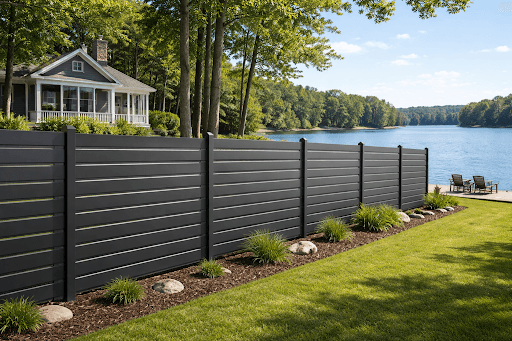
Black is the default for a reason. It works against almost every house exterior, including red brick, beige stucco, white siding, grey board-and-batten, and natural cedar accents. It frames a yard cleanly without competing with landscaping. The popularity of black aluminum fencing in Canada is no accident. It hides dirt, road salt residue, and the slow accumulation of pollen better than lighter colours, which means fewer noticeable stains between annual rinses.
Black also makes the architectural lines of an aluminum panel read more sharply. A semi-privacy panel in matte black looks geometric and modern from across a yard. The same panel in a wood-grain finish looks softer and more residential. Neither is wrong; they are different design statements for different homeowners.
The honest tradeoff with black is heat. A black aluminum surface in direct summer sun absorbs more solar radiation than a lighter colour. For a fence, this means the panel surface can get noticeably warm to the touch on a hot July afternoon. It is not dangerous, and it does not damage the coating, but it is worth noting if you have small children or pets who lean against the fence frequently. Wood-grain panels generally absorb less heat than pure matte black because the surface tone is lighter and more varied.
Wood-grain aluminum fence finishes: what they actually look like up close
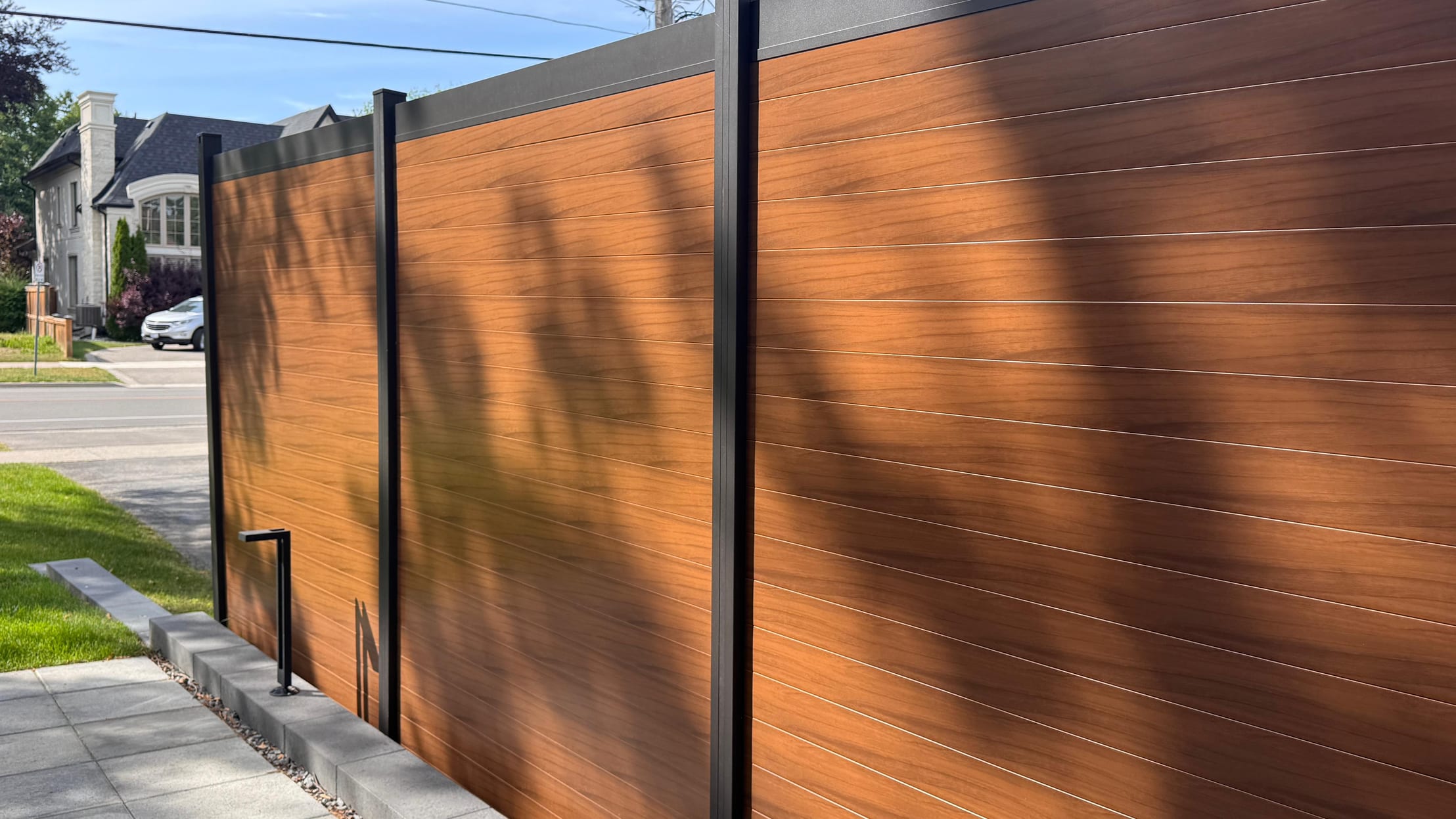
Wood-grain finishes are the largest growth segment in residential aluminum fencing in Canada, and the reason is straightforward. Homeowners want the warmth and visual texture of a cedar or teak fence without the maintenance, splitting, and grey weathering that real wood fences develop within one or two seasons in this climate. A wood-grain aluminum fence delivers the look without the structural decline.
The five wood-grain finishes in the PrimeAlux lineup each pull from a different tone family:
- Natural Walnut. The lightest of the five, with a warm honey-brown base and visible grain. Pairs well with white, light grey, or beige homes. Reads the closest to fresh, unstained cedar.
- Walnut. A mid-tone brown that sits between honey and chocolate. Versatile enough to work against most exteriors. The closest analog to a stained cedar finish that has aged a year or two indoors.
- Dark Walnut. A deep, rich brown with strong contrast in the grain. Works well against modern grey, charcoal, or black homes for a layered look. Hides dirt and lawn debris better than lighter wood-grains.
- Grey Walnut. A cool grey-brown with the texture of weathered wood, but without the actual weathering damage. Pairs cleanly with contemporary builds, light siding, and white trim.
- Grey Brown. A neutral muted tone, between grey and brown, that disappears into landscaping rather than competing with it. A common pick when the fence should support the design rather than dominate it.
All five are produced through the same multi-step coating process, so the durability profile is consistent across the range. Colour selection is a design decision, not a performance compromise. Custom wood-grain matches outside this lineup are available upon request through the PrimeAlux showroom.
How aluminum fence colours compare to wood and vinyl finishes
The colour conversation looks very different across fence materials. Wood gives you natural tone for the first season and then changes whether you want it to or not. Vinyl is locked into whatever shade comes off the extrusion line, with limited options and a tendency to fade visibly under Canadian sun. Aluminum sits between them, offering a wide colour range with engineered colour stability.
| Material | Colour Range | How Colour Holds Up in Canada | Maintenance to Keep Colour |
|---|---|---|---|
| Aluminum (PrimeAlux) | Black plus 5 wood-grain finishes, custom available on request | Holds colour through freeze-thaw cycles and summer UV, typically 25+ years before any visible degradation | Rinse occasionally with water and mild soap. No staining, sealing, or repainting required. |
| Cedar wood | Natural cedar tone at install only; greys quickly | Cracking, greying, and warping start within 1 to 2 seasons regardless of quality | Stain or seal every 2 to 3 years. Most homeowners skip this, which accelerates decay. |
| Pressure-treated wood | Greenish tint at install, fades to grey | Same visible deterioration as cedar; warps and cracks within 2 years | Regular treatment required. Chemicals can leach over time. |
| Vinyl | White, beige, tan, sometimes grey or brown | Fades, yellows, and can become brittle. Cheap imported vinyl shows colour loss earlier than premium product. | Periodic cleaning. Cannot be repainted; once a section is faded, the only fix is replacement. |
| Chain link | Galvanized silver or vinyl-coated black/green | Coating wears at contact points; rusts where coating fails | Low effort, but rusted sections cannot be refinished easily. |
The most common wood comparison is the simplest: a wood fence looks beautiful on day one and starts cracking, greying, and warping inside two seasons in Canadian climates. By the time it is structurally failing at year 8 to 12, it has been visually unattractive for most of its life. Side-by-side performance data on aluminum versus wood fences in Canada tells the same story across every climate region. Aluminum holds its appearance for the entire life of the fence. The same pattern shows up in aluminum versus vinyl comparisons, where vinyl colour fade is the most visible long-term failure.
Pro Tip: Bring real samples home before you commit
Showroom lighting is rarely the same as the light hitting your house at 4 p.m. in June. Before you finalize a colour, ask for physical sample swatches you can hold against your siding, roof, and trim in your own yard at different times of day. The “perfect grey walnut” in a sales bay can read warmer or cooler in real outdoor light, and the only way to catch that is to look at it where the fence will actually live. PrimeAlux can provide samples for evaluation through the Mississauga showroom or through dealer partners.
How to match an aluminum fence colour to your home
The fence is a frame, not a feature wall. The goal is for the colour to support the architecture of your home, not compete with it. A few practical rules cover most Canadian homes.
Match the trim, not the siding. If your house has black window frames, black gutters, or black trim, a black aluminum fence will look intentional rather than random. The same logic applies to dark wood-grain fences against homes with brown trim, soffits, or doors. Matching the largest exterior surface (the siding) often makes the fence feel like an extension of the wall, which is rarely the desired effect.
Contrast against light backgrounds, blend into dark backgrounds. A black or dark walnut fence pops cleanly against white, beige, or pale grey siding. Against a charcoal or dark brown home, a lighter wood-grain like natural walnut or grey walnut creates more visual interest than another dark element.
Consider the landscape, not just the house. If your yard backs onto trees or has heavy plantings, wood-grain finishes integrate with the natural environment in a way that black does not. If your yard is open, manicured, or features architectural plantings, black tends to read more deliberately.
Think about scale. A long privacy fence in a strong colour creates a visual wall. If the fence will run more than 60 feet uninterrupted, a wood-grain finish often softens the visual weight. A short run of fence near a pool or patio can carry a stronger black with no issue.
Heat, fade, and chalking: what really happens to fence colour over time
Three colour failure modes show up over the life of a fence. Fade is the slow loss of colour saturation, where a deep brown drifts toward beige or a black drifts toward charcoal. Chalking is a powdery white residue on the coating surface caused by UV breakdown of the binder. Peeling, blistering, or flaking is adhesion failure where the coating actually separates from the aluminum.
On a quality multi-coat aluminum fence, all three are slow processes. The architectural coating standards published by the Fenestration and Glazing Industry Alliance (formerly AAMA) describe accelerated weathering tests that quality coatings are expected to pass before they fail visibly. Real-world performance for properly applied finishes routinely exceeds 25 years in residential conditions.
On budget aluminum imports with single-coat finishes, the same failure modes can appear in 3 to 7 years. The visual signs are easy to spot once you know what to look for: a fence that looks dusty even after rinsing (early chalking), a colour that no longer matches replacement panels (fade), or hairline lines where the coating has lifted along an edge (adhesion failure). This is one reason vague language like “premium aluminum” without a tested coating spec should be treated with skepticism. Specific coating standards and confirmed test data, like ASTM E84 fire performance and tested wind load to 220 km/h, are the real differentiators between products that look the same in a sales photo.
Do colour and finish affect heat absorption, energy, or sustainability?
For a fence, heat absorption is more comfort than physics. A darker fence panel will be warmer to the touch than a lighter one in direct summer sun, but the thermal mass of an aluminum panel is small enough that it does not meaningfully heat a backyard or affect adjacent grass. The principle of solar absorption on dark surfaces is well documented in building science, but a fence is a thin vertical element, not a roof, and the energy implications are minimal.
Sustainability is more interesting. Aluminum is among the most recyclable construction materials available. Industry data from The Aluminum Association documents recycling rates and the closed-loop nature of aluminum production. PrimeAlux uses up to 70% recycled aluminum content in its panel and post systems. The colour layer does not affect recyclability; the coating is removed during the smelting process and the underlying aluminum returns to circulation. For homeowners pursuing LEED credits or simply preferring a lower-impact material, recycled aluminum content is a real and verifiable benefit, regardless of the colour you select. The same recycled material runs through the rest of the product range, including aluminum privacy screens and standalone panel systems.
Will the colour match if you add panels later?
This is one of the most overlooked questions when homeowners pick a finish. Wood and vinyl fences both have well-known colour matching problems. A new cedar board next to weathered cedar looks like a patch. A new vinyl section next to faded vinyl reads as a different product entirely.
Aluminum fences hold their colour, which means a panel installed 5 years from now should match the panels you install today, provided you order the same finish from the same manufacturer. PrimeAlux maintains its standard wood-grain colours as ongoing production items rather than seasonal runs, so future orders should match within a small tolerance. Custom colour matches are also reproducible from the original specification.
This matters in three real-world cases. The first is property expansion, where you fence the front yard now and the back yard later. The second is partial replacement, where one section of fence is damaged by a fallen branch and needs to be swapped. The third is gate addition, where a homeowner adds an aluminum gate to an existing fence run and wants it to read as one continuous installation. For any of those scenarios, recording the exact colour and finish at the time of original purchase is worth the 30 seconds it takes to write down.
What the buying process looks like in Canada
Once you have selected a colour, the rest of the process is fairly standard. A typical residential aluminum fence project in Canada runs $80 to $120 per linear foot installed, including panels, posts, gates, and labour. The colour itself rarely changes the price within a manufacturer’s standard finish range; black and the standard wood-grains are usually priced the same. Custom RAL-matched colours add cost and lead time and are quoted on request.
Site-specific factors affect price more than colour does. Slope, the need for stepped panels, aluminum gate count, post depth (PrimeAlux recommends 3 ft minimum burial below grade for residential applications), and access affect installed cost noticeably. A walkable city lot is much cheaper to fence than a sloped country lot with restricted equipment access. For a closer look at the line items, the Canadian aluminum fence cost guide breaks down typical residential project pricing in detail. Federal and provincial guidance on residential building practices is available through CMHC and provincial building code resources, and reputable installers will be familiar with local bylaws around setback, height, and pool enclosure.
For PrimeAlux specifically, all panels in any colour are tested to 220 km/h wind load and rated Class A under ASTM E84 (Flame Spread Index 0, Smoke Developed Index 50). The full ASTM E84 test data sheet is available for review. Those performance numbers do not change between black and wood-grain options. The colour decision is purely aesthetic. For ongoing care, a basic aluminum fence maintenance routine applies the same way regardless of which finish you select.
Frequently asked questions
What is the most popular aluminum fence colour in Canada?
Black is the most popular aluminum fence colour in Canada by a wide margin. It works against almost every home exterior, hides dirt and road salt residue, and frames a yard cleanly. Wood-grain finishes are the fastest-growing segment, particularly walnut and grey walnut tones for homeowners who want the look of cedar without the maintenance.
Do dark aluminum fences get hot in the sun?
A dark aluminum panel in direct summer sun is warmer to the touch than a lighter panel. It is not dangerous and does not damage the coating, but it is worth knowing if young children or pets lean against the fence often. The thermal mass of an aluminum panel is small, so the warming does not meaningfully heat the surrounding yard.
How long does an aluminum fence keep its colour in Canada?
Quality aluminum fences with multi-layer coatings typically hold their colour for 25 years or more in Canadian conditions before any visible fade or chalking appears. Single-coat budget products can show colour failure in as little as 3 to 7 years, particularly on south-facing fence runs with heavy sun exposure.
Can you repaint an aluminum fence a different colour?
Aluminum fences can technically be repainted with the right preparation, but the original factory-applied multi-layer coating will always outperform a field-applied paint job. The smarter play is to choose the right colour upfront. If a colour change is necessary, hiring a coating professional with experience on architectural aluminum gives the best chance of a finish that lasts.
Are wood-grain aluminum fences more expensive than black?
Within a given manufacturer’s standard finish range, black and standard wood-grain finishes are usually priced the same. Custom RAL-matched colours add cost and lead time. Wood-grain finishes do not require a higher-grade aluminum; the underlying panel and post hardware are identical across the colour range.
Will my new aluminum fence panels match the old ones if I add to the fence later?
Yes, provided you order the same finish from the same manufacturer. Aluminum fences hold their colour, so panels installed years apart should match within a small tolerance. Record the exact colour and finish at the time of original purchase to make future ordering simple.
What is the difference between a wood-grain finish and real wood?
A wood-grain finish is a multi-layer coating on aluminum that mimics the look and texture of wood. The underlying material is aluminum, which does not rot, warp, crack, or grey. Real wood looks identical at install but starts cracking, greying, and warping within one to two seasons in Canadian climates. The wood-grain aluminum delivers the look without the structural and aesthetic decline.
Can I see physical samples before I commit to a colour?
Yes. PrimeAlux provides physical sample swatches through the Mississauga showroom and through dealer partners across Canada. The samples can be held against your siding, trim, and roof in actual outdoor light, which is the only reliable way to evaluate how a colour will read on the finished fence.
Choosing a colour that you will still like in ten years
The single best piece of advice for picking an aluminum fence colour is to take it slowly. The fence will outlast the trend cycle. A finish that feels bold and exciting on the day of selection should still feel right when you walk into the backyard four summers from now. For most Canadian homeowners, the safe long-term choices are black for a clean modern look, walnut or dark walnut for a warm traditional look, or grey walnut for a contemporary build that will pair well with the next generation of exterior trends.
If you are weighing options for a project this season, the team at PrimeAlux can walk through samples, pricing, and panel layout in person at the Mississauga showroom or by appointment. Reach out for a quote that includes the specific colour and panel style you are considering, and ask for sample swatches to evaluate in your own yard before you commit. The fence is a 25-plus-year decision, and the colour deserves more than a 10-minute browse on a website.