Aluminum Fence Brackets: A Canadian Homeowner’s Guide to Connectors, Mounts and Hardware
Quick Summary
Aluminum fence brackets are the metal connectors that lock panels to posts, hold rails square, and transfer wind and snow loads down into the ground. Choosing the right bracket type, fastener length, and spacing is what separates a fence that stays straight for 25 years from one that loosens after two winters. This guide covers every bracket type used in a typical Canadian residential install, with sizing, placement, and the common mistakes that cause callbacks.
What Are Aluminum Fence Brackets and Why Do They Matter?
Aluminum fence brackets are the small but load-bearing metal pieces that connect horizontal rails to vertical posts. Every panel in a fence run passes its weight, wind force, and snow load through brackets before that force reaches the post and the footing. If the bracket fails, the panel sags, the rail twists, or the whole section pulls away from the post during a winter storm.
In a finished aluminum fence, you usually do not see the brackets. They sit either inside a routed pocket on the post or behind a slim cover plate. That visual cleanliness is part of why aluminum has overtaken wood as the default privacy choice for new Canadian builds. The hardware does the structural work quietly. But during installation, getting the brackets right is the difference between a system that holds a 220 km/h wind-load tested panel in place and one that lets the panel rattle loose.
A properly chosen bracket distributes load evenly along the rail, keeps the panel flush against the post, and resists corrosion through the freeze, thaw, and salt cycles that define every Canadian winter. The wrong bracket, or the right bracket installed with the wrong fastener, undoes everything the panel is engineered to do.
What Are the Main Types of Aluminum Fence Brackets?
Five bracket types do the bulk of the work in a residential aluminum fence system. Each one solves a specific connection problem, and most installs use a combination of three or more.
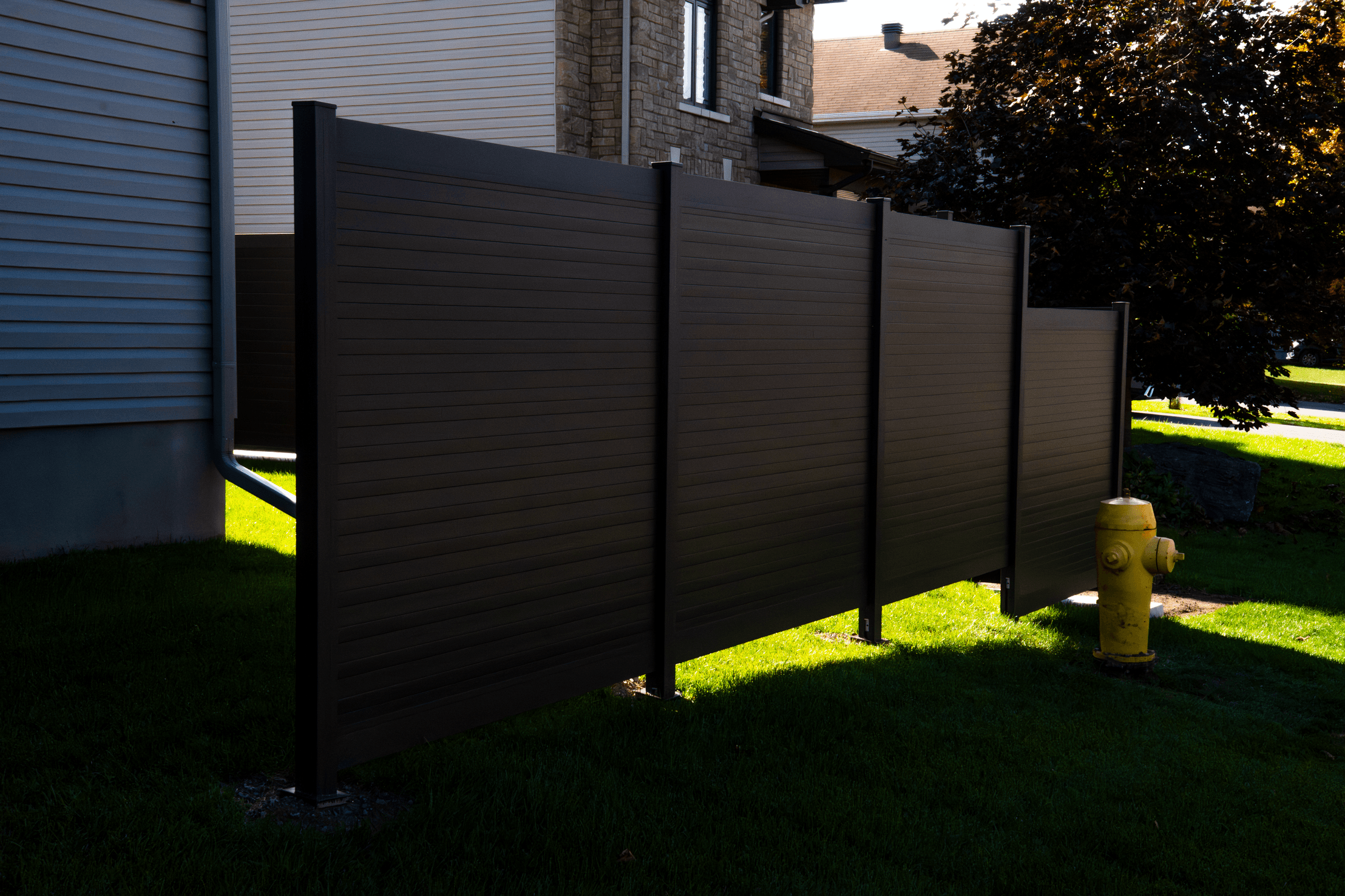
Straight-line rail brackets connect a rail to a post when the run is going in a straight direction. They are the most common bracket in any fence and account for roughly two-thirds of the brackets used in a typical residential install.
Swivel brackets handle slopes and grade changes. When a yard rises or falls between posts, the rail needs to follow the grade without forcing the post out of plumb. Swivel brackets pivot from 0 to about 35 degrees, depending on the model, and let the panel rake without distorting the post-to-rail joint.
Corner brackets handle the 90-degree turns at property edges. Some systems use two straight brackets meeting at the corner post, while others use a dedicated L-shaped corner bracket. Either approach works if the corner post is properly footed.
Wall mount brackets attach the start or end of a fence run directly to a brick, stone, or stucco wall. They are common when a fence ties into the side of a house or a garage. The fastener requirement here is critical and depends entirely on the wall substrate.
Stair-step brackets are a specific kind of swivel bracket designed for terraced or stepped panel runs. Instead of letting the rail rake with the grade, stair-step brackets keep each panel level and step the panels down between posts.
Aluminum Fence Bracket Sizing and Spacing
Bracket sizing in residential aluminum fence systems is largely standardized by panel height. The bracket itself is matched to the rail profile, which in turn is matched to the panel system. You do not pick brackets independently of the panel line you choose. What you do control is how many brackets per panel, where they sit on the post, and how they are fastened.
For a standard PrimeAlux 6-foot privacy panel, two brackets per rail are standard. Most panels carry two rails (top and bottom), so each panel uses four brackets total. Taller panels in the Privacy Plus line with foam-core construction may use a middle rail in higher wind zones, taking the bracket count to six per panel. Panels run from 4 ft x 6 ft up to 8 ft x 8 ft, with custom sizes also available.
Vertical spacing matters as much as bracket count. The bottom bracket sits about 6 inches above grade in most residential installs, the top bracket about 4 to 6 inches below the panel cap, and any middle bracket roughly centered between them. This spacing distributes wind load across the panel face rather than concentrating it at the top, which is where rails fail first when bracket placement is wrong.
Which Bracket Type Should You Use? A Quick Comparison
Most homeowners do not pick brackets directly. The installer or supplier matches the bracket to the panel system and the site conditions. Still, knowing which bracket goes where helps you ask the right questions when comparing quotes.
| Bracket Type | Where It Goes | Typical Use Case | Common Mistake |
|---|---|---|---|
| Straight rail bracket | Mid-run, flat ground | Standard panel connection, both rails | Over-tightened fastener strips post material |
| Swivel bracket | Sloped or graded yards | Up to about 35° rake on either side | Forcing a swivel beyond its rated angle |
| Corner bracket | 90° turns and property corners | Tie two runs into one corner post | Undersized corner post footing |
| Wall mount bracket | Start or end at a building | Anchoring fence to brick, stucco, or wood-framed wall | Using deck screws instead of masonry anchors |
| Stair-step bracket | Steep slopes where panels step | Each panel stays level, runs step down post to post | Skipping the bracket and racking the panel instead |
Fasteners: What Actually Holds the Bracket in Place?
The bracket is only half of the connection. The other half is the fastener. A correctly sized fastener in the wrong material is one of the most common installation failures in residential aluminum fencing, especially in Canadian climates where temperature swings stress every metal joint.
Stainless steel screws are the default for aluminum fence brackets. They resist galvanic corrosion when in direct contact with the aluminum, and they hold their tension through freeze and thaw cycles. Standard zinc-plated screws may look fine on installation day, but in two to three Canadian winters they begin to rust at the head, stain the panel face, and lose grip strength.
For wall mount brackets going into brick or stone, the fastener changes entirely. You need a sleeve anchor or wedge anchor rated for the substrate, not a screw. The Canadian wood-frame industry standard for fasteners into solid wood is a 3-inch construction screw, but masonry needs a different approach: drill, anchor, then bolt. Skipping the anchor step is the single biggest cause of wall-mount fence failures during the first big windstorm.
Fastener length matters too. Going too short means the screw never bites into the post wall thickness, so the bracket pulls loose under wind load. Going too long can punch through the back of the post, leaving a corrosion point and a sharp edge inside the post cavity. Most aluminum posts are designed for a specific screw length called out by the panel manufacturer, and the safest approach is to use exactly what they specify.
How Do Brackets Handle Canadian Wind, Snow, and Frost?
A fence in Canada has to survive three loads that fences in milder climates rarely see together. Sustained winter wind, ice and snow pressure built up on the panel face, and frost heave lifting the post footing from below. Brackets sit at the joint where all three meet.
PrimeAlux panels are independently tested for both fire performance under the ASTM E84 standard (Class A, with a Flame Spread Index of 0 and a Smoke Developed Index of 50) and wind load up to 220 km/h. Those test numbers only mean something if the brackets actually transfer the load they describe. A panel rated for 220 km/h with a stripped bracket fastener performs at whatever the bracket can hold, which can be a small fraction of the rated number.
For snow load, the issue is usually drifting against the panel face. A 6-foot privacy panel with a 1-foot snow drift can carry several hundred pounds of lateral force at the bracket points. Properly placed brackets, spread top to bottom, share that load. Brackets bunched at the top of the panel will allow the bottom to bow outward, distorting the panel permanently.
For frost heave, the bracket itself is not the fix. The fix is the post footing. Aluminum fence posts in Canada should be buried 3 ft into the ground, below most regional frost lines, with a concrete footing around the post. Regional frost depth recommendations vary by province and municipality, and national resources on climate and environment are a useful starting point for understanding regional ground conditions. If the post moves with frost, the bracket cannot save the panel. Get the footing right first, and the bracket does the rest. Read more in our Canadian frost line post depth guide.
Where Do Most Bracket Installations Go Wrong?
Bracket failures in residential fencing rarely come from the bracket itself. The most common causes are install errors that bypass the spec. Five mistakes account for most call-backs.
Wrong fastener material. Zinc-plated or coated steel screws against aluminum cause galvanic corrosion at the joint. Use stainless. This is the single most common failure point in a 5-year-old fence.
Skipping wall anchors. Brick, stucco, and stone walls need sleeve or wedge anchors rated for the substrate. Driving a deck screw into mortar joints feels solid on installation day, but it pulls within two seasons under any meaningful wind load.
Over-tightening. Aluminum is softer than steel. An installer using a high-torque impact driver can strip the post wall around the bracket hole, leaving the bracket loose with nothing to grip. Hand-tightening the last quarter-turn is the safer habit.
Wrong angle on swivels. Swivel brackets are rated to a specific angle. Forcing them past that angle to follow a steep grade cracks the swivel pin or distorts the bracket body. On grades steeper than the rating, switch to stair-step brackets and step the panels.
Skipping the middle rail. On 8-foot panels or in high-wind zones, dropping the middle rail to save cost on brackets is a false economy. The panel face flexes more, the top rail carries more lateral load than it was designed for, and the install loosens earlier.
Bracket Care and Long-Term Maintenance
One of the reasons aluminum has overtaken wood, vinyl, and chain link as the default for new residential builds is that the bracket-to-post system needs almost no maintenance. There is no rust to treat, no rot, no staining required, and no annual inspection beyond a visual once-over.
What does help: once a year, walk the fence and check the rails for any movement at the bracket points. If a bracket has worked loose, retorque the fastener. Catching one loose bracket before winter is a 30-second fix. Letting it ride through three freeze-thaw cycles can elongate the bracket hole and turn it into a panel replacement. For more on long-term fence performance, see our aluminum fence lifespan guide.
Compare this against wood fencing, where the rail-to-post connection is a nailed or screwed butt joint that loosens every season as the wood swells and shrinks. Or vinyl, where the connector tabs become brittle below about -20°C and crack on impact. Aluminum brackets with stainless fasteners do not have an analogous failure mode. The Aluminum Association notes that aluminum is infinitely recyclable without quality loss, and Natural Resources Canada tracks domestic aluminum production and recycling activity that supports the Canadian supply chain, which is part of why PrimeAlux panels use up to 70% recycled content while still meeting full structural specs.
How Much Should Brackets Add to Your Fence Cost?
Brackets are usually included in the per-linear-foot price of a residential aluminum fence quote, not itemized separately. A typical installed Canadian aluminum fence runs $80 to $120 per linear foot, and the bracket hardware accounts for a small but non-trivial portion of that, usually 5 to 8 percent. See our full aluminum fence pricing breakdown for Canadian homeowners for context.
If a quote separately itemizes brackets at a high markup, that is a flag worth investigating. So is a quote that does not specify the bracket type or fastener spec at all. Reputable installers identify the bracket system by manufacturer and include the spec sheet on request. Custom panel sizes (PrimeAlux offers configurations from 4’x6′ up to 8’x8′, with custom dimensions available) usually do not change bracket cost meaningfully, since the bracket count scales with panel rail count, not panel width.
One pricing trap to watch for in the market: imported aluminum fence kits sold at low headline prices often arrive with light-gauge brackets and zinc-plated fasteners, even when the listing claims “marine-grade hardware.” Verify the bracket material and fastener spec in writing before purchase. Tested test data from Canadian wind load and ASTM fire performance is harder to fake than a marketing claim, so look for it.
Frequently Asked Questions
Can I install aluminum fence brackets myself?
Yes, on a flat run with standard panels, bracket installation is within reach for a confident DIYer. The job becomes harder when grades change, when wall-mount anchors are needed, or when the fence runs across a property corner. For installations larger than about 50 linear feet, or any install requiring masonry anchors, working with an installer is usually faster and lower risk. Our step-by-step aluminum fence install guide walks through the full process.
What’s the difference between a bracket and a connector?
The terms are often used interchangeably in the residential market. Strictly, a bracket holds a rail to a post, while a connector might join two rails end-to-end or splice two posts at a corner. In practice, most suppliers and installers use “bracket” as the umbrella term, and we use it that way in this guide.
Do aluminum fence brackets work for gates?
Standard rail brackets do not carry the load of a gate. Gates use a separate hinge system, usually a self-closing hinge set, plus a latch and stop. The gate post (the post the gate hinges from) is also typically larger and more deeply footed than a standard line post. For gate hardware specifically, see our guide to aluminum gate systems or the recent post on sliding gate hardware for Canadian homeowners.
What fasteners come with the brackets?
This varies by manufacturer. PrimeAlux includes the matched stainless fasteners with every panel and bracket kit. Some imported kits ship with plain or zinc-coated screws to save cost. If you receive a kit with non-stainless hardware, replace the fasteners before installing. The cost is small compared with replacing brackets after corrosion sets in.
Are aluminum brackets stronger than the panel?
Not necessarily, and that is by design. In a properly engineered fence system, the bracket-fastener combination is the weakest point and is intended to absorb impact before the panel itself deforms. A direct hit (a falling tree branch, a vehicle bumper) should ideally bend the bracket and let the panel be reused or replaced cleanly, rather than crack the panel face. This makes repairs cheaper and faster.
Can I reuse brackets if I move a fence?
Sometimes. Brackets that have not been over-tightened, distorted, or corroded can be reused. Fasteners should always be replaced. The hidden cost of reusing a worn fastener is that it may bottom out in a stripped hole and feel tight when it has no actual grip. New fasteners are inexpensive, so this is one place not to economize.
How do I match new brackets to an existing aluminum fence?
If you know the manufacturer and panel system, the supplier can identify the matching bracket directly. If the panel system is unknown, measure the rail profile, the post wall thickness, and the existing bracket dimensions, and bring photos to a fencing supplier. Mixing bracket systems between manufacturers usually does not work, since rail profiles vary between product lines.
Do bracket colours match the panel finish?
Yes. PrimeAlux brackets come in the same colour and finish family as the panels they support: Natural Walnut, Grey Walnut, Walnut, Dark Walnut, and Grey Brown, all applied with a 3-layer coating process for UV and impact resistance. The brackets are mostly hidden in finished installs, but matching the finish prevents any visible mismatch where the bracket edge meets the panel.
Getting the Bracket System Right Pays Off for 25 Years
Brackets are the part of an aluminum fence that most homeowners never think about and most quotes never itemize. They are also the part that decides whether the fence still looks straight, tight, and clean in 2050. Choose a panel system with engineered, matched brackets in stainless hardware, install them per spec, and the rest of the system does its job for decades. Cut corners on the bracket or the fastener, and you put every other engineered spec at risk.
For a quote on a Canadian aluminum fence with engineered bracket systems and matched stainless fasteners, contact PrimeAlux directly through the main site, or browse the privacy fence, semi-privacy fence, and Privacy Plus foam-core panel options to see the matched hardware that comes with each system.