Pool Fence Canada: Provincial Requirements Every Homeowner Needs to Know
Every summer, Canadian parents and homeowners with backyard pools face the same conversation: do we have the right fence, and does it actually meet code? Provincial pool enclosure rules are more detailed than most people expect, and the consequences of getting it wrong range from a failed inspection to something far more serious.
This guide walks through what each province requires, how different fence materials perform against those standards, and what to look for when choosing or replacing a pool fence in Canada. The goal is to give you enough information to make a confident decision, get through inspection, and install a fence that holds up through decades of Canadian winters.
PrimeAlux aluminum fence panels are designed to meet and exceed North American pool enclosure requirements. Learn more about the PrimeAlux privacy aluminum fence or browse the full range of residential fence systems for Canadian homeowners.
What the National Building Code Says About Pool Enclosures
The National Building Code of Canada sets baseline requirements for pool enclosures that apply across the country. Provinces and municipalities then adopt, modify, or exceed those minimums depending on local legislation. The result is a patchwork of rules that share the same core logic but differ in some specifics.
The core national baseline includes:
- A minimum enclosure height of 1.2 metres (approximately 4 feet)
- Openings in the fence no larger than 100mm (about 4 inches) in any direction
- At least one gate that is self-closing and self-latching
- Latch hardware positioned on the pool side of the gate, out of reach of young children
- No objects within 1 metre of the outside of the fence that could be used as a climbing aid
Provinces are allowed to adopt the NBC as-is or add more stringent rules. Some Ontario and Quebec municipalities, for example, require enclosures that completely separate the pool from the house (meaning the house itself cannot serve as one of the enclosure walls). Check with your local building department before designing your fence layout.
Pool Fence Requirements by Province
Requirements vary by province but share common principles: minimum 1.2m height, self-closing gates, and openings no wider than 100mm. Some provinces set higher minimums or add additional gate hardware requirements. Always confirm with your local municipality before purchasing.
| Province | Minimum Height | Key Gate Rule | Notes |
|---|---|---|---|
| Ontario | 1.2m to 1.8m, varies by municipality | Self-closing, self-latching; latch on pool side | Set by municipal bylaw, not the Ontario Building Code (e.g. Toronto Municipal Code Ch. 447: 1.2m/1.8m; Hamilton, Ottawa: 1.5m) |
| British Columbia | 1.22m (4 ft) | Self-latching; latch min 1.5m high or pool-side only | BC Building Code Div B; gate must not be climbable |
| Alberta | 1.2m (4 ft) | Self-closing and self-latching required | Alberta Building Code; check local municipal bylaws for additions |
| Quebec | 1.2m (4 ft) | Self-closing, self-latching; latch on pool side | Act Respecting Safety in Sports; pool-side latch access required |
| Manitoba | 1.2m (4 ft) | Same NBC baseline applies | Manitoba Building Code follows NBC minimums closely |
| Saskatchewan | 1.2m (4 ft) | Self-closing, self-latching | Some municipalities require permit before pool installation |
| Nova Scotia / NB / PEI | 1.2m (4 ft) | NBC baseline; local bylaws may vary | Always confirm at the municipal level before construction |
One important note: the table above reflects general provincial minimums. Municipal bylaws can require additional height, specific hardware, or permits. Cities like Toronto, Vancouver, and Calgary often have supplemental rules beyond the provincial baseline. Contact your local building department before purchasing materials.
Gate and Hardware Requirements for Canadian Pool Enclosures
Every compliant pool fence needs a gate that closes and latches on its own, without any input from the person using it. Self-closing and self-latching are two separate requirements that are both mandatory. A gate that closes but needs to be manually latched does not meet code.
A few gate hardware rules that catch homeowners off guard:
- Latch position: The latch must be on the pool side of the gate, positioned high enough that a young child cannot reach up and open it. In most provinces this means the latch sits at least 1.2 to 1.5 metres above the ground.
- No gap at the bottom: The gap between the bottom of the gate and the ground must be no more than 100mm, the same as the fence panels.
- No footholds: Gates must be smooth on the outside. Horizontal bars, decorative rails, or wide frames that a child could use as a climbing aid are not permitted as the outermost surface.
- Swing direction: Gates must swing away from the pool, so that a child pushing against the gate falls back rather than forward into the pool area.
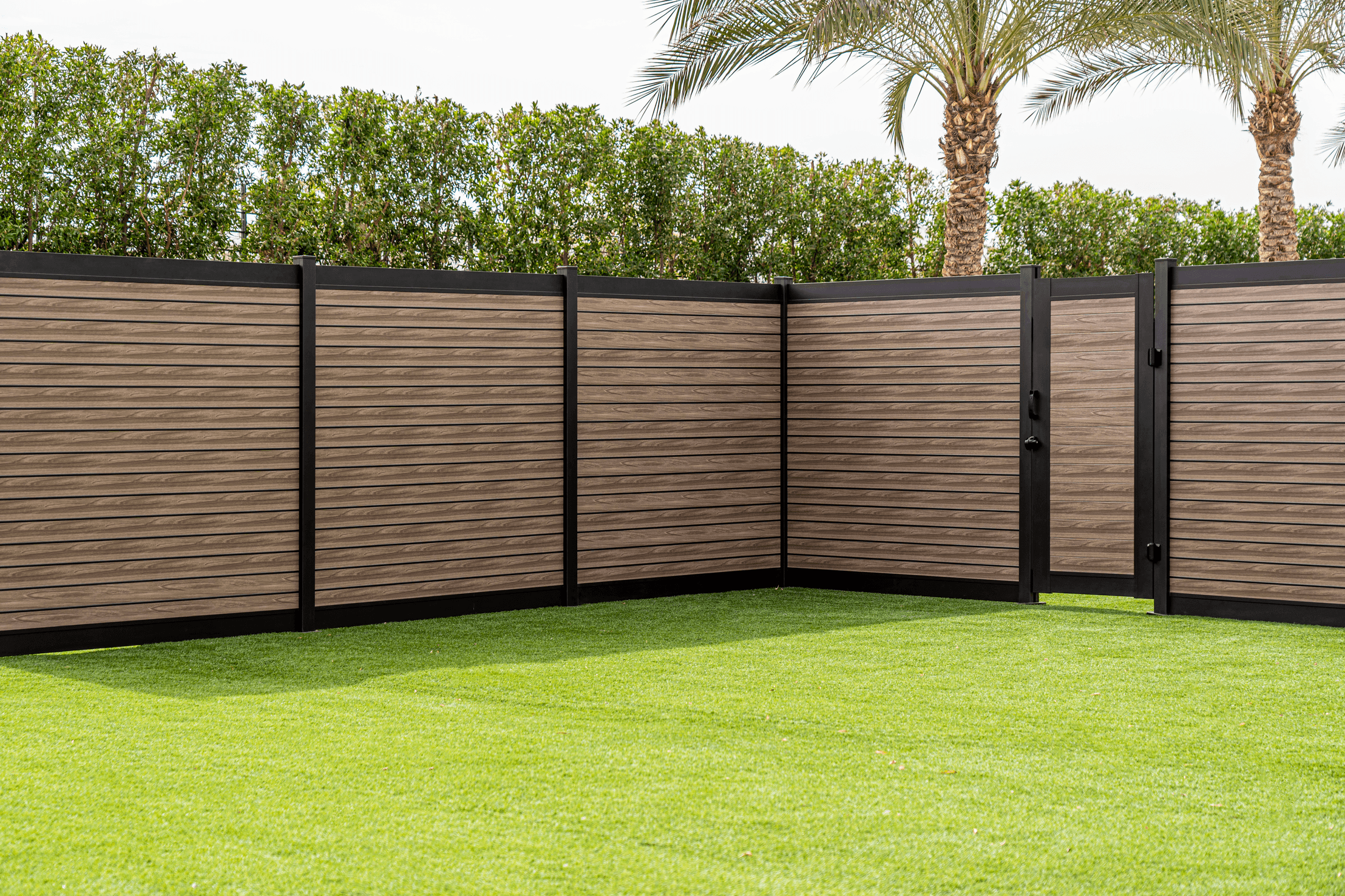
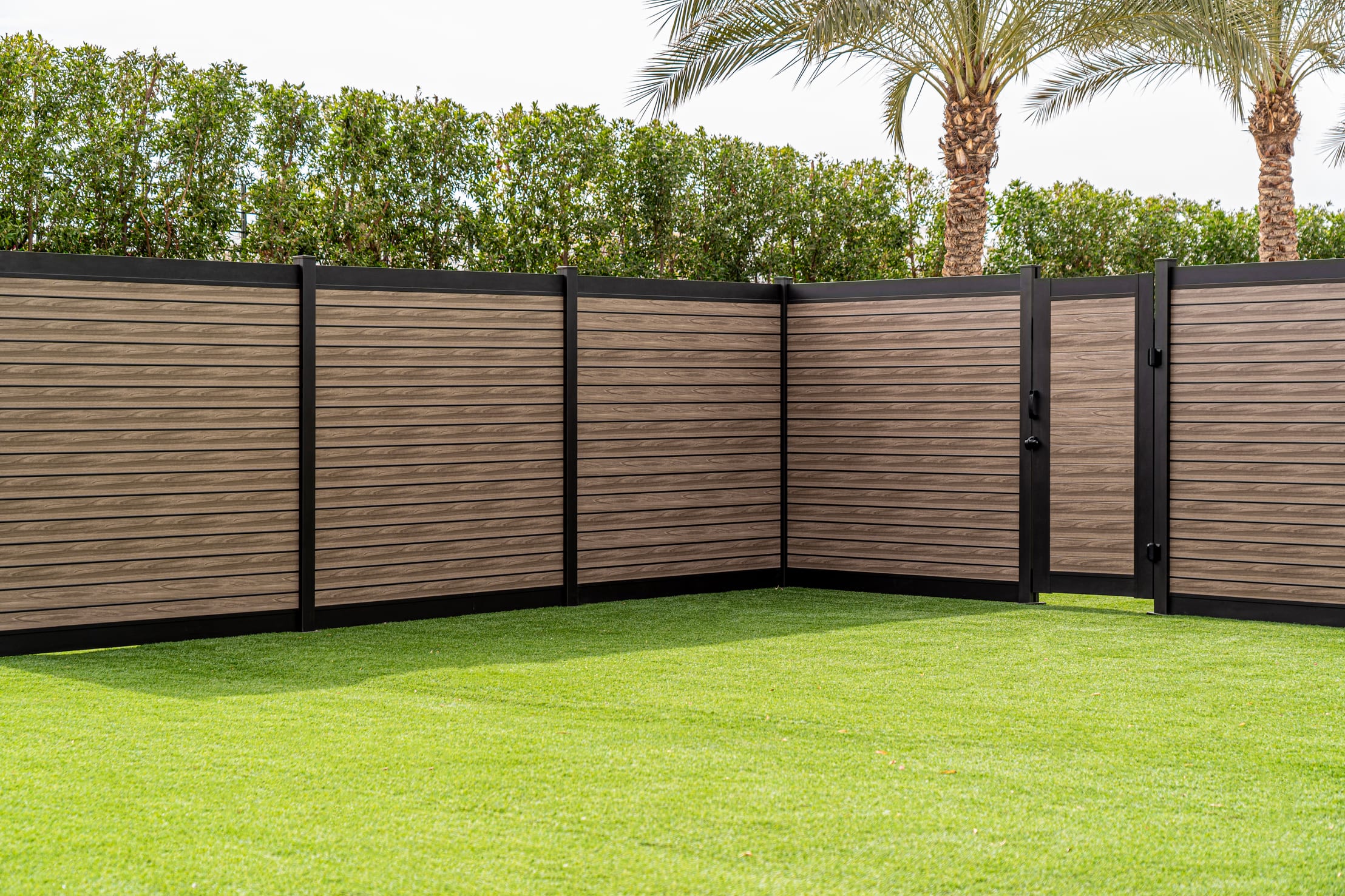
PrimeAlux aluminum pool gates are designed to work with industry-standard self-closing hinges and spring-loaded self-latching hardware. The panels and gates are available in matching wood-grain and solid colour finishes so the gate blends cleanly with the rest of the enclosure.
Which Fence Material Holds Up Best for Pool Enclosures in Canada?
Aluminum is the most reliable pool fence material in Canada. It meets provincial code requirements without modification, handles freeze-thaw cycles without cracking or warping, and does not rust when exposed to pool chemicals, chlorine splash, or standing water from rain and snowmelt.
Here is how the main options compare in a Canadian pool fence context:
| Material | Meets Code (Height) | Pool Exposure | Freeze-Thaw | Maintenance |
|---|---|---|---|---|
| Aluminum (PrimeAlux) | Yes, available in code heights | Fully resistant, no rust or corrosion | No cracking, warping, or heaving | None required |
| Vinyl / PVC | Yes, code heights available | Chlorine exposure accelerates fading and brittleness | Cracks in extreme cold (below -20°C) | Cleaning; replace cracked panels |
| Wood (Cedar) | Yes, if built to spec | Absorbs water, swells, rots around the base | Warps and splits with repeated freeze-thaw | Stain every 2-3 years; replace rotted posts |
| Wrought Iron / Steel | Yes | Rusts near pool chemistry; requires coating maintenance | Stable structurally but finish degrades | Paint/coating renewal every few years |
| Chain Link | Meets height minimums but climbable | Galvanized resists rust short-term | Stable | Low, but may fail climbability rule |
A word on vinyl: the 10-year estimate for vinyl pool fencing assumes quality materials and normal conditions. Many imported vinyl products sold in Canada operate well below that threshold, showing cracking and brittleness within five to seven years when subjected to pool-adjacent chlorine exposure and Canadian winter temperatures. Vinyl also cannot be repaired when it cracks; the panel or section must be fully replaced, which adds cost over the fence’s life.
Wood fences around pools have a shorter functional lifespan than wood fences in dry settings because of the constant moisture exposure (rain, splash,, condensation, and irrigation) all work against the material. Posts buried underground near a pool tend to rot significantly faster than standard yard posts. The structural integrity of a wood pool enclosure declines well before the fence looks obviously damaged, which creates a safety concern that goes beyond aesthetics.
Pool Fence Costs in Canada: What to Budget
Aluminum pool fencing costs in Canada vary by project; contact a supplier for a current quote. The exact number depends on the fence height you choose, the number of gate openings required, post depth, and any excavation needed for buried post footings.
Most standard backyard pools in Canada require 30 to 60 linear feet of fencing, depending on pool size and whether the house forms one side of the enclosure. Contact a supplier for a current quote based on your enclosure's total linear footage; pool gates are typically priced separately given the hardware requirements.
Wood fencing costs less upfront, typically $42 to $85 per linear foot installed for cedar or pressure-treated. But over 10 years, the combination of staining costs, post replacements, and early re-fencing typically closes the gap significantly. Aluminum has no ongoing maintenance cost and a lifespan of 25 or more years in Canadian conditions.
For pricing specific to your property, contact PrimeAlux directly for a quote. Panel sizes range from 4’x6′ up to 8’x8′, with custom dimensions available to fit non-standard pool layouts.
Common Pool Fence Mistakes That Fail Inspection
Most pool fence inspection failures fall into a handful of predictable categories. Knowing them before you build saves time and the cost of having to modify or replace materials after the fact.
1. Wrong height on the gate. The fence panels clear 1.2 metres but the gate drops two centimetres shorter. Even a small gap matters: inspectors measure from the top of the gate, not the top of the adjacent fence panel. Order the gate and fence panels from the same manufacturer to guarantee consistent height.
2. Latch hardware on the wrong side. The latch is installed on the outside of the gate instead of the pool side. This is one of the most common errors and fails code in every province. The latch must be positioned so it can only be accessed by reaching over or through the fence from the pool side.
3. Horizontal rails that allow climbing. Some fence designs include horizontal rails at the mid-height and top of the fence. If those rails are on the outside-facing surface and spaced so a child could use them as a ladder, they fail the climbability requirement. PrimeAlux panels place frame elements in orientations that pass this check, but confirm with your fence supplier before ordering if you have a custom design.
4. Objects too close to the outside of the fence. A raised garden bed, a stored kayak, a compost bin, even a stacked patio chair, anything within one metre of the outside of the fence that could help a child climb over it will be flagged. Plan the surrounding area before the inspection date.
5. Post footings that don’t reach frost line. This is not technically a pool enclosure code item, but posts that shift or lean because footings are too shallow will fail a structural assessment and create a real safety issue. In most of Canada the frost line runs to at least 1.2 metres, and for pool fencing specifically, post burial depth of 3 feet is the confirmed minimum for PrimeAlux installations.
Why Aluminum Is the Right Choice for Pool Enclosures in Canada
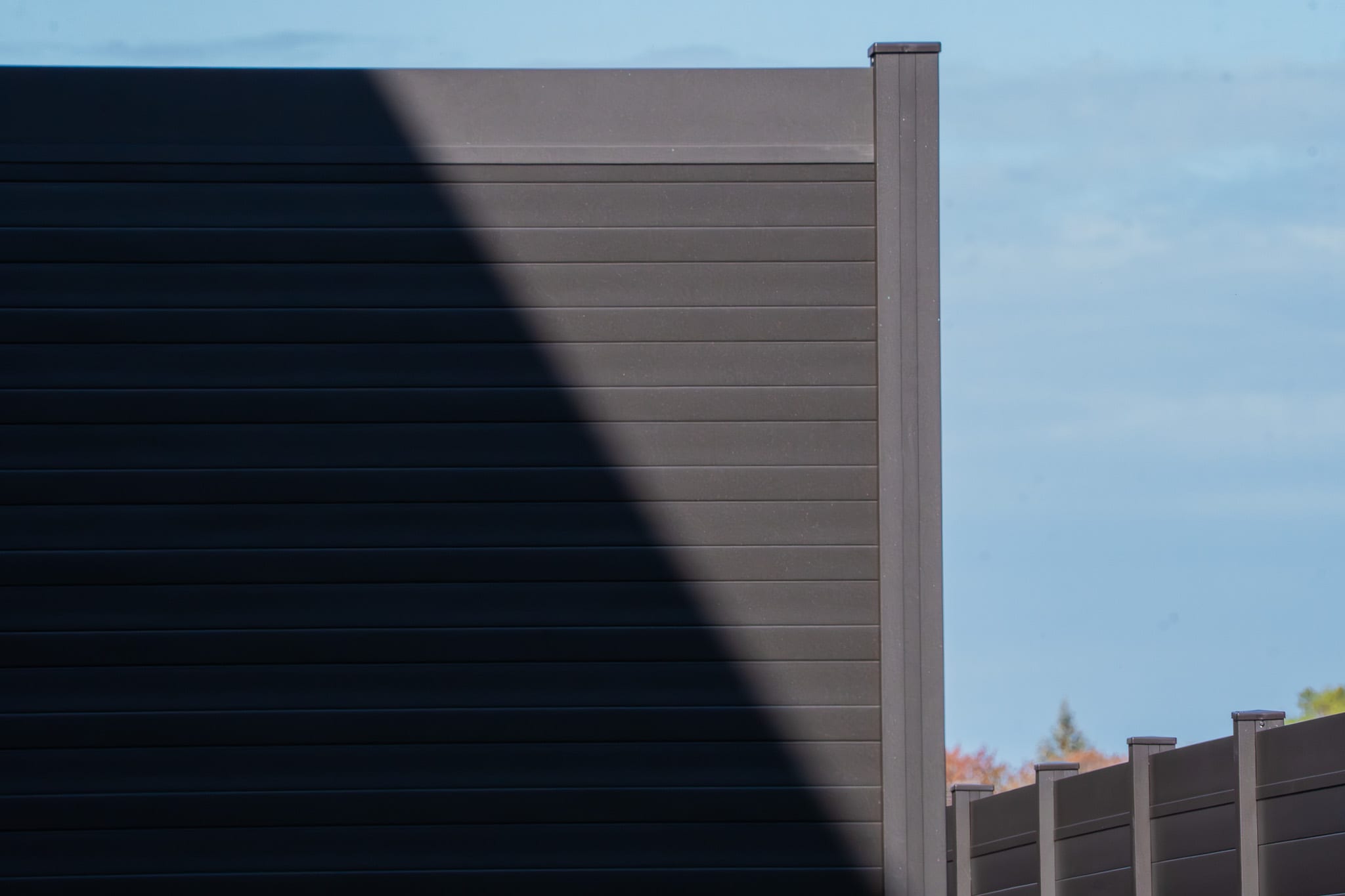
Aluminum combines every property that a Canadian pool fence needs. It does not absorb moisture, so it will not rot, swell, or delaminate around the pool perimeter. It does not rust, so chlorine splash and irrigation water have no long-term effect on the fence’s finish or structural integrity. It holds its dimensions through the full range of Canadian temperatures, from -35°C Ontario winters to summer highs above 35°C, without cracking, bowing, or pulling free from post hardware.
PrimeAlux aluminum fence panels are wind-load tested to 220 km/h and carry a Class A fire rating under ASTM E84 (Flame Spread Index 0, Smoke Developed Index 50). The foam-core construction in the Privacy Plus line adds thermal and acoustic performance on top of the structural baseline. Up to 70% recycled aluminum content is used in manufacturing.
For pool enclosures specifically, the privacy aluminum fence gives full visual seclusion of the pool area, which matters for homeowners who prefer not to have the pool visible from the street or from neighbouring properties. The semi-privacy aluminum fence offers visibility between the slats while maintaining the structural properties needed for a compliant enclosure.
Gates are available in matching finishes and can be configured for single or double openings. All gate hardware is compatible with industry-standard self-closing hinges and spring-loaded latches. See the full aluminum gates selection for pool enclosure-compatible options.
For homeowners comparing panel styles and specs in detail, the PrimeAlux privacy fence panel spec page includes complete panel dimensions, available heights, and product certifications.
Pool Fence Canada: Frequently Asked Questions
Is a pool fence legally required in Canada?
Yes. Every province in Canada has legislation requiring pool enclosures for residential swimming pools. The specifics vary, but a compliant fence around any outdoor pool with a water depth of 600mm (about 24 inches) or more is required under provincial building codes and local bylaws. Failure to comply can result in fines and invalidates your property insurance in some cases.
What is the minimum height for a pool fence in Canada?
The National Building Code minimum is 1.2 metres (approximately 4 feet). Some provinces and municipalities require higher. Always confirm with your local building department. For most standard backyard pools in Ontario, BC, and Alberta, 1.2 metres is the accepted minimum, though taller fences offer better separation between the pool area and the rest of the yard.
Do pool fences need to be a specific material?
No specific material is mandated in most Canadian building codes. Aluminum, wood, vinyl, wrought iron, and chain link are all technically permitted if they meet the structural and height requirements. Aluminum is preferred for Canadian climates because it does not rust, rot, or crack in freeze-thaw conditions, and it requires no maintenance to maintain structural integrity over decades.
Can the house wall count as one side of the pool enclosure?
In some provinces, yes, but not all. Several provinces allow the house itself to form one wall of the pool enclosure as long as all doors and windows that open into the pool area meet specific requirements (self-closing, self-latching, or alarmed). Ontario and some Quebec municipalities require a full perimeter fence that is separate from the house. Always confirm with your local building department before designing the enclosure layout.
Do pool fence gates need to be self-closing?
Yes, in every province. Self-closing means the gate returns to the closed position on its own without requiring anyone to push it shut. Self-latching means the latch engages automatically when the gate closes. Both requirements apply simultaneously. A gate that closes but must be manually latched does not meet code in any Canadian jurisdiction.
How much does a pool fence cost in Canada?
Aluminum pool fencing typically runs $80 to $120 per linear foot installed for residential properties in Canada. A standard backyard pool requiring 30 to 60 linear feet of fencing will cost between $2,400 and $7,200 before gates. Gates are priced separately and include the additional cost of compliant self-closing and self-latching hardware. Contact PrimeAlux for a specific quote based on your property dimensions.
What openings are allowed in a pool fence?
Openings in any direction must be no larger than 100mm (about 4 inches). This applies to gaps between vertical slats, between the bottom of the fence and the ground, and between the top of any horizontal rail and the next element above it. This rule is designed to prevent a young child from passing through or getting their head stuck. PrimeAlux panels are manufactured with consistent spacing that meets this requirement.
How deep should pool fence posts be set in Canada?
Pool fence posts should be buried at least 3 feet (approximately 900mm) into the ground for structural stability in Canadian soil conditions. In regions with a deeper frost line (common in Ontario, Quebec, and the Prairie provinces), confirm the footing depth with your installer to ensure the post base sits below the frost line and will not shift or heave during winter. PrimeAlux systems are designed for this burial depth as a standard installation specification.
For a detailed breakdown of post depth and installation requirements across Canadian soil types, see the PrimeAlux guide on Privacy Plus aluminum fence installation.
To review panel and post specs in full technical detail, visit the Privacy Plus fence panels page on primealux.com.
Get the Right Pool Fence for Your Property
A pool fence has one job: to keep unauthorized access to the pool area prevented, particularly for young children. In Canada, that requirement is backed by provincial building codes, and meeting it requires more than just putting up a fence at the right height. The gate hardware, the opening sizes, the post depth, and the proximity of surrounding objects all factor into compliance.
Aluminum remains the most practical material for this application in Canada. It meets the structural requirements, handles the climate without maintenance, and does not introduce long-term material failure risks that would compromise the enclosure’s integrity over time.
To discuss pool enclosure options for your property, browse the privacy aluminum fence range or aluminum gate options on primealux.ca. For technical specifications and product certifications, visit primealux.com.